Who said that?

It happened to Einstein, Marilyn, Washington & more: 12 famous misquotes


Published on June 15, 2025


Image: Hannes Richter

Some of history’s most often repeated sayings were never actually said. At least not by the people we love to credit. You have probably read dozens of quotes wrongly attributed to Albert Einstein or Oscar Wilde, but Marilyn Monroe also made the list. As did Marie Antoinette! Today, we are setting the record straight on some of the most stubborn quote myths.

1

"Let them eat cake"

Image: Karina Kungla

Despite her reputation for extravagance, there’s no evidence that Marie Antoinette ever uttered these words. The quote "Qu'ils mangent de la brioche" is often pinned on her as a symbol of her indifference to the hardships of starving peasants.

However, the phrase first appears in Jean-Jacques Rousseau’s Confessions, which he started writing in 1765, when Marie was just about nine years old and still living in Austria.

2

"I cannot tell a lie"

Image: Maud Bocquillod

The famous story about young George confessing to chopping down a cherry tree is pure fiction, cooked up by biographer Mason Locke Weems after Washington’s death.

There’s no evidence Washington ever said this. Weems simply wanted to craft a moral and visually memorable legend for America’s first president.

3

"The ends justify the means"

Image: Pixabay

While "The Prince" does argue that rulers sometimes need to be ruthless, Niccolò Machiavelli never wrote "the ends justify the means."

The phrase is a simplified (and distorted) summary of much more complicated ideas he discussed about power and politics.

4

"And yet it moves"

Image: Andrii Khrystian

The force of the Roman Inquisition fell upon Galileo, the father of modern astronomy who defended heliocentrism. He supposedly muttered this famous phrase after being forced to counter his views, defending that the Earth did move around the sun.

However, there’s no contemporary record of the defiant line being spoken. It first appeared decades later, in a biography written well after Galileo’s death.

5

"Be the change you wish to see in the world"

Image: Ishant Mishra

Michael Jackson did sustain that he was starting by changing "the man in the mirror," and Mahatma Gandhi probably would have agreed. But the exact words of the famous line were never said by the real Gandhi.

His advice was much more nuanced about personal responsibility and social reform. The polished quote is a bit of a paraphrase meant to capture his philosophy in a nutshell.

6

"Well-behaved women rarely make history"

Image: Martin Péchy

You can thank Marilyn Monroe for a lot, but not this quote. Although often typed on posters next to her iconic photos, the line was actually written by historian Laurel Thatcher Ulrich in a 1976 scholarly article.

She wasn’t encouraging rebellion either: She was observing that history tends to overlook women who "color inside the lines."

7

"Elementary, my dear Watson."

Image: Soyoung Han

Sir Arthur Conan Doyle wrote many lines spoken through his famous detective, Sherlock Holmes. But this one –perhaps the most often repeated line– wasn’t among them!

Yes, Watson was Holmes’ dear sidekick, and probably Sherlock used the word "elementary" at some point. Still, the straight line "Elementary, my dear Watson" cannot be found anywhere in the original texts.

8

"Be yourself. Everyone else is already taken"

Image: Lisa from Pexels

Oscar Wilde, a master of aphorisms, had wit to spare. Many lines can be attributed to him. This one, however, doesn’t ring like those by the author of The Picture of Dorian Gray.

The saying doesn't appear in any of his writings or documented conversations. It likely emerged around the end of the 20th century, stitched together by fans who loved the idea of Wilde’s spirit.

9

"Insanity is doing the same thing over and over again…"

Image: Andrew George

"... and expecting different results." You might have read this quote and felt inspired by it. Although often attributed to Albert Einstein, there's no record of him saying it.

Some say that the earliest known appearance is in a 1980s Narcotics Anonymous pamphlet. The internet did its job and blurred the origins of the quote.

10

"Far from the maddening crowd"

Image: Tom Wheatley

This one is only slightly incorrect. Thomas Hardy fans, take note: The correct line is "far from the madding crowd." And, in fact, Hardy borrowed it from Thomas Gray’s 1751 poem Elegy Written in a Country Churchyard, which read "Far from the madding crowd's ignoble strife." "Madding" meant frenzied, not "maddening."

11

"Winning isn't everything; it's the only thing"

Image: Giorgio Trovato

Vince Lombardi gets the credit, but even he said he was misquoted! The original line came from UCLA coach Red Sanders, who reportedly told his team this hard-hitting slogan in the 1950s. Lombardi’s version was similar but way less cutthroat: He said, "Winning isn't a sometime thing; it's an all the time thing."

12

"The British are coming!"

Image: Pixabay

Paul Revere didn’t actually yell this because, back in 1775, that would have been confusing. Most colonial Americans still considered themselves British.

What he likely said was something closer to "The Regulars are coming out" or "The Redcoats are on the move." He also didn’t yell, since secrecy was key for his mission.


Names that lie

Mountain chickens are frogs? 10 animals with misleading names


Published on June 15, 2025


Image: Jo Taylor

Some animals have commonly been given names that might lead you to believe false things about them. For example, as we all know, guinea pigs are not pigs, sea horses are not horses, and starfish are neither stars nor fish. So, how did these names come to be? While lookalike allegations may justify some, others are simply far-fetched. Is there any truth or reason behind these inaccurate nicknames—like "firefly"? Let’s explore 10 animal names that are, arguably, misnomers.

1

Mountain Chicken

Image: Yaroslav Savateikin

Let’s start with one of the most far-fetched names on this list. Mountain chickens aren’t birds at all—they’re large frogs. And they don’t live in mountains, either. These frogs are found mostly in the Caribbean, inhabiting lowland rainforests and swamps. A more accurate and realistic name for them is "giant ditch frogs," which refers to their large size and their tendency to dwell near water bodies.

So, how did they get this name? The story goes that locals found the frog’s meat similar in taste and texture to chicken. Yes, this now critically endangered species was once considered a delicacy in local cuisines.

2

Red panda

Image: Flickr

You would think that the red panda is just a smaller, red version of the giant panda. After all, they share cute faces, patches around their eyes, and similar snouts and ears. But you’d be wrong—red pandas are not bears.

Here’s the explanation: The word "panda" is believed to derive from the Nepali word ponya, which refers to animals with claws adapted for eating bamboo. This is the biggest trait red and giant pandas have in common: their heavily bamboo-based diets. Red pandas, sometimes nicknamed "firefoxes," belong to a mammal family of their own and are more closely related to skunks than to giant pandas.

3

Titmouse

Image: Matthew Goeckner

Titmouses aren’t rodents—did you know? Instead, they are songbirds known for their gray or bluish-gray feathers. One of the most common species is the tufted titmouse, and you’ll be pleased to know that the plural form is, indeed, "titmice."

The name "titmouse" comes from Old English, where tit referred to a small creature, and mase was a general term for a bird. Over time, mase became obsolete, and "titmase" was transformed into "titmouse" due to the similarity between the words. Arguably, there’s also some physical resemblance between the gray color and beady, round eyes of both titmice and mice.

4

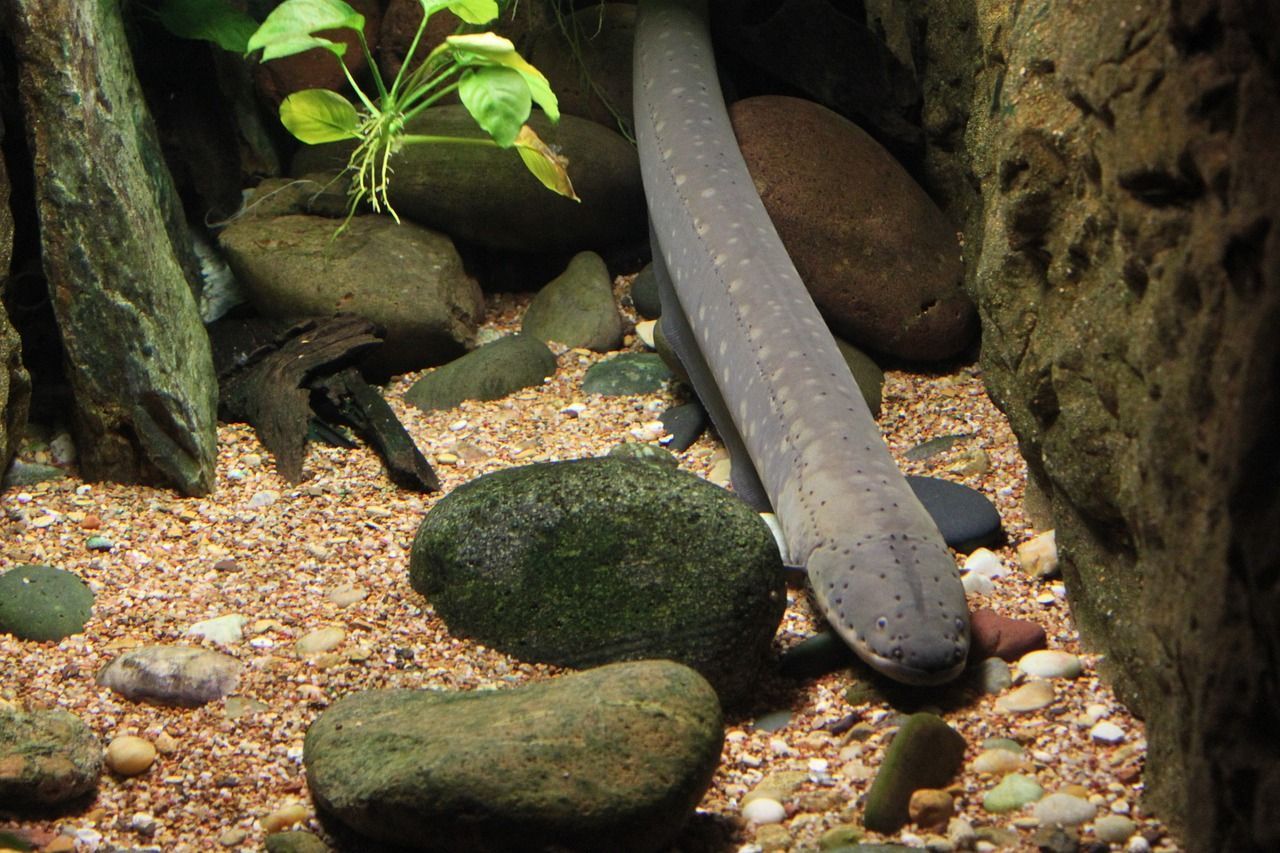
Electric eel

Image: k10legs

Yes, the name "electric eel" is misleading—but not for the reasons you might think. These aquatic animals are indeed capable of generating shocks of electricity, up to ​​860 volts, which they use to stun their prey or defend themselves. However, strictly speaking, they are not eels.

Unlike true eels, which belong to the family Anguillidae, electric eels are part of the knifefish family and are more closely related to catfish. Early European explorers misnamed them based on their elongated, eel-like bodies.

5

Seahorse

Image: Sergiu Iacob

Seahorses are fish, just like salmon or clownfish. Arguably, they look nothing like those species. Instead, for centuries, humans have noticed their resemblance to horses. Seahorses have a distinctive upright swimming posture, elongated heads and necks, and a caudal fin that even resembles a horse’s mane.

Their scientific name, Hippocampus, is borrowed from the Ancient Greek word hippókampos. Interestingly, the term didn’t originally refer to this animal but to a mythological marine creature. In Greek, hippos means "horse," and kampos means "sea monster."

6

Guinea pig

Image: Jack Catalano

Guinea pigs aren’t pigs—nor are they from Guinea, the West African country. Instead, they are rodents native to South America. By now their name has become synonymous with "experiment subject" because of how frequently they were used in scientific research.

There are a couple of theories behind their misleading name. The "pig" part likely comes from the squealing noises they make, which resemble those of piglets. As for "guinea," it might derive from the British coin of the same name, implying they were sold for its equivalent value. Another theory is that European sailors, associating distant Guinea with anything exotic, mistakenly applied the name to these South American rodents.

7

Koala bear

Image: Valeriia Miller

The koala is often called a "koala bear," but it’s not a bear at all. European settlers in Australia gave it this name because its round face and fluffy ears reminded them of bear cubs.

Koalas are, in fact, marsupials. Like kangaroos, they carry their young in pouches. The word koala comes from the Dharug language (an Aboriginal language of Australia) and is believed to mean "no water," referring to the koala's ability to survive on eucalyptus leaves with minimal water intake. Did you know? Eucalyptus leaves are low in nutrients and mildly toxic. As a result, koalas have a slow metabolism and sleep up to 20 hours a day.

8

Firefly

Image: Tony Phan

Fireflies don’t handle fire. They do, however, possess the ability to produce light, a phenomenon called bioluminescence. This light creates the illusion of tiny flames flying through the night. No wonder they have been associated with magic and fascination for centuries.

Despite their name, fireflies aren’t flies—they’re beetles. They produce light through a chemical reaction in their abdomens, which they use to attract mates or communicate. In fact, ​​different firefly species flash in distinct rhythms to help them identify each other.

9

Prairie Dogs

Image: Werner Hilversum

The first time you hear the term "prairie dogs," you might picture packs of dogs roaming freely across the prairies. In reality, these animals are rodents and belong to the ground squirrel family.

The name is believed to have been given by early European settlers due to their high-pitched sounds. Prairie dogs are capable of producing sophisticated and varied calls to communicate with one another, sometimes sounding like man’s best friend. The "prairie" part of their name comes from their habitat—vast grasslands and prairies across North America. These rodents are expert burrowers and typically live in small family groups called "coteries," where members groom and protect each other.

10

Ladybug

Image: Pixabay

It’s not only that ladybugs aren’t all female—they aren’t truly bugs, either. Instead, they are a type of beetle. These round and colorful insects have been widely associated with good luck and fortune for centuries. The reason for this has to do with the story behind their nickname.

The name "ladybug" originated in the Middle Ages, when farmers prayed to the Virgin Mary for help with pests in their crops. The beetles, which helped control aphid populations, were called "Our Lady's birds" or "Our Lady's beetles," later shortened to "ladybirds" or "ladybeetles." Over time, much to the frustration of entomologists, this evolved into the popular term "ladybugs."

Looking for an extra scoop of literary fun?

Learn more with our Word of the day

overtone

/ˈoʊvərˌtoʊn/