Odd plurals

Of Mice and People: The history of irregular plurals


Published on September 13, 2026


Image: Photo by Compagnons on Unsplash

Usually, plural English nouns are pretty straightforward. Just add an -s or -es, and you're done. However, there are more than a few odd ones out: words that change their vowels, acquire unexpected endings, or become almost unrecognizable. These irregular nouns are not random: they are linguistic leftovers from older forms of English and from the many languages that contributed to its vocabulary. Here's a list of 10 irregular plurals that are considerably more interesting than simply adding an -s.

1

Mice

Image: Photo by Nick Fewings on Unsplash

While the plural of mouse looks like an exception today, it is actually a survivor from a much older way of forming plurals called i-mutation, common in Old English and many Germanic languages. It's the same process that gave us geese, feet, teeth, and lice, among others.

English eventually abandoned this system in favor of the -s and -es mechanism for building plurals, but these words survive as remnants of the old times.

2

Children

Image: Photo by note thanun on Unsplash

Children is an interesting case of what linguists call double plurals: words that conserve two different marks of plurality in their construction.

The Old English word cild was pluralized as cildru originally, and eventually as childre. As the language evolved, speakers added the plural suffix -en (also found in words like oxen and brethren) to form the word children. In effect, the word accumulated two markers of plurality.

English normally has a strong tendency to simplify these cases, which makes the survival of the word children (instead of childs) especially remarkable.

3

Cacti and Cactuses

Image: Photo by Thomas Verbruggen on Unsplash

Cactus is a good example of what happens when English borrows a word, but speakers can't quite decide whether to keep the original language's grammar. The word entered English from Latin, and the traditional Latin plural of cactus is _cacti.

_However, English has its own perfectly sensible way of making plurals, and that has produced the word cactuses. In modern English dictionaries, both words are accepted. Cacti sounds more traditional and is particularly common in botanical contexts, while cactuses sounds more natural to everyday speakers.

4

Octopuses, Octopi, and Octopodes

Image: Photo by Dear Sunflower on Unsplash

Few English plurals generate as much debate as octopus. You'll commonly encounter octopuses, octopi, and, more rarely, octopodes. So which one is correct?

The popular form octopi comes from the mistaken assumption that octopus is a Latin word ending in -us and should therefore form its plural with -i, just like cacti. In reality, the word comes from the Greek oktōpous, meaning "eight-footed." Following Classical Greek rules, the plural should be octopodes.

While octopodes is closer to the original Greek, it's only common in specialized discussions. For ordinary English, octopuses is the simplest and most widely accepted choice.

5

Data

Image: Photo by Markus Spiske on Unsplash

In Latin, the singular datum means something that has been given, and data is its plural. English borrowed both forms, particularly in scientific and academic writing, where the distinction has remained important for centuries.

Today, datum is much less common outside of specialized contexts. While in formal scientific writing data is often still treated as plural, in everyday use many speakers treat it as a singular mass noun, as in "The data is stored on the server." The plural has effectively become more widespread than its original singular.

6

Phenomena

Image: Photo by Constantinos Kollias on Unsplash

Phenomenon is another Greek word whose traditional plural has survived intact. In Greek, phainomenon referred to something that appears or is observed, while phenomena was its plural. English borrowed the pair through Latin and preserved the Greek-style ending.

Unlike cactus, where English developed an alternative plural, phenomena remains firmly established in educated and technical writing. It is especially common in science, where researchers may discuss multiple natural phenomena.

7

Brothers and Brethren

Image: Photo by juan pablo rodriguez on Unsplash

Both brothers and brethren are perfectly valid plurals of brother. However, in a surprising twist, they took on different nuances: while brothers is used for male siblings ordinarily, brethren (the older form) survived mainly in religious, fraternal, and formal contexts.

Brethren was once a normal plural of brother, but as English developed, the regular -s plural became increasingly dominant. Rather than disappearing completely, the older form became specialized. That gives us a fascinating example of a word developing two different plurals that coexist because they acquired different meanings.

8

Dice

Image: Photo by Riho Kroll on Unsplash

The word die, referring to a single numbered polyhedron (most commonly a cube) used in games, entered English through the Old French , while dice developed from the French plural dés.

While the distinction is still very much in use, the singular die is losing strength in everyday English, and dice is increasingly being treated as both a plural and a singular noun. In time, the singular form die may disappear from everyday English vocabulary.

9

People

Image: Photo by Ryoji Iwata on Unsplash

People is an especially interesting plural because it didn't originally come from the same word as person. The two words have completely different Latin origins.

Person ultimately comes from Latin persona, meaning a person, character, or role. People comes from Latin populus, meaning a population or nation, passing into English through French. Over time, English speakers began using people as the ordinary plural of person, even though the two words had separate histories.

The regular plural persons still exists and is perfectly legitimate, particularly in legal and formal contexts when referring to a group of individuals. But in ordinary conversation, people has become overwhelmingly dominant.

10

Indexes or Indeces

Image: Photo by Maksym Kaharlytskyi on Unsplash

Index has two established plurals, and the choice between them often depends on what you're talking about. Indexes is the ordinary English plural, while indices preserves the Latin form and is especially common in mathematics, science, and economics.

The Latin plural indices survived in specialized fields because scholars continued using Latin-derived terminology. Meanwhile, ordinary English speakers naturally applied the familiar -es ending and produced indexes. Both forms are now standard.



Hospital secrets

What is a "Code Gray" and what you should know if you hear it at the E.R.


Published on September 13, 2026


Image: voronaman

A trip to the emergency room can be stressful enough without hearing doctors and nurses speak a language that sounds like a secret code. One minute, someone is asking for medication "STAT," the next there’s a "Code Gray," and another patient is suddenly "NPO." What do those words really mean? Some are official medical terms, others are insider slang, but they all help hospital staff communicate quickly when every second counts. Here are 10 of those codes explained.

1

Code Gray

Image: PeopleImages

The E.R. can be hectic and unpredictable. Most patients are frightened or uncomfortable, but now and then someone becomes aggressive because of pain, confusion, mental illness, or the effects of alcohol or other substances. That’s when you can hear "Code Gray" announced over the speakers.

The code is used to summon security officers to help manage a violent or combative situation. While color codes vary from one hospital to another, Code Gray commonly signals that staff needs extra assistance to protect patients, visitors, and healthcare workers. Even if you know it now, most people in the waiting room never know what happened, and that’s exactly the point.

2

NPO

Image: PeopleImages

You have a scheduled surgery, you’re in your bed waiting to be taken to the surgery room, and you ask for a cup of coffee to make the wait lighter. The nurse will probably tell you you’re an NPO. You may think it’s serious, but it’s simply a procedure.

"NPO" is an abbreviation that comes from the Latin phrase Nil Per Os, which means "nothing by mouth." It tells patients they cannot eat, drink, or sometimes even take medication until doctors say it’s safe. The rule is most common before surgery or certain medical tests, when food or liquids could increase the risk of complications or alter the results. It may be frustrating, but it’s an important part of keeping patients safe.

3

STAT!

Image: PeopleImages

You’ve probably been through the experience of visiting an emergency room, either to get checked or to visit a loved one. In that part of the hospital where everyone is rushing to save lives, you’ve probably heard a doctor asking for the R.C.P. cart or medication "STAT!" It sounds urgent, and that's because it is.

The expression comes from the Latin statim, which means "immediately" or "without delay." Hospitals have used Latin medical terms for centuries, but STAT is one of the few that remains part of everyday conversation. When a doctor says it, the request jumps to the top of the priority list. It doesn’t always refer to a life-or-death situation, but it does mean the medical team needs something done as quickly as possible.

4

Code Pink

Image: Vladimir Tretyakov

Newborns are always a reason to celebrate at the hospital. Parents usually rest happily next to their child as they receive congratulations from close relatives. However, the hospital is always prepared to handle extremely rare emergencies under "code pink."

If you hear a "Code Pink," it usually means a baby or young child is suspected of being abducted from the hospital. Within seconds, security officers respond, exits may be monitored or blocked, and staff begins following carefully rehearsed procedures. Although different hospitals sometimes use different color codes, Code Pink has become widely recognized across North America as one of the most serious alerts a hospital can issue.

5

Walkie-talkie

Image: Arunporn Thanapotivirat

If you’ve ever spent a few days in the hospital, you’ve probably noticed that some patients are walking up and down the halls, while others need help just getting out of bed. When a nurse refers to someone as a "walkie-talkie," it’s actually good news.

This informal expression refers to patients who can walk on their own, use the bathroom without assistance, and handle most basic tasks independently. It’s not an official medical term, of course, but it’s commonly used among healthcare workers because it quickly tells the next shift that the patient requires less hands-on care than many others.

6

Total

Image: sebra

As nurses change shifts, you’ll often hear them give a quick report about each patient. One person may only need medication, while another is described as a "total."

The term is short for a patient who requires total care. They may need help eating, bathing, getting dressed, turning in bed, or moving from one place to another. Although the expression sounds impersonal, it’s simply a practical way for caregivers to communicate how much assistance someone needs.

7

Frequent flyer

Image: Studio Romantic

Most people hear "frequent flyer" and think of an airline reward program. And that’s correct, but in an emergency room, the phrase has a very different meaning.

A frequent flyer is an informal nickname for patients who repeatedly return to the hospital, often due to chronic illness, recurring medical conditions, or other ongoing health issues. Behind the light-hearted nickname is often a difficult reality. Many of these patients are simply dealing with medical problems that require regular emergency care, and the expression is just a way to make the experience a bit lighter among the familiar faces of doctors and nurses.

8

WOW

Image: Studio Romantic

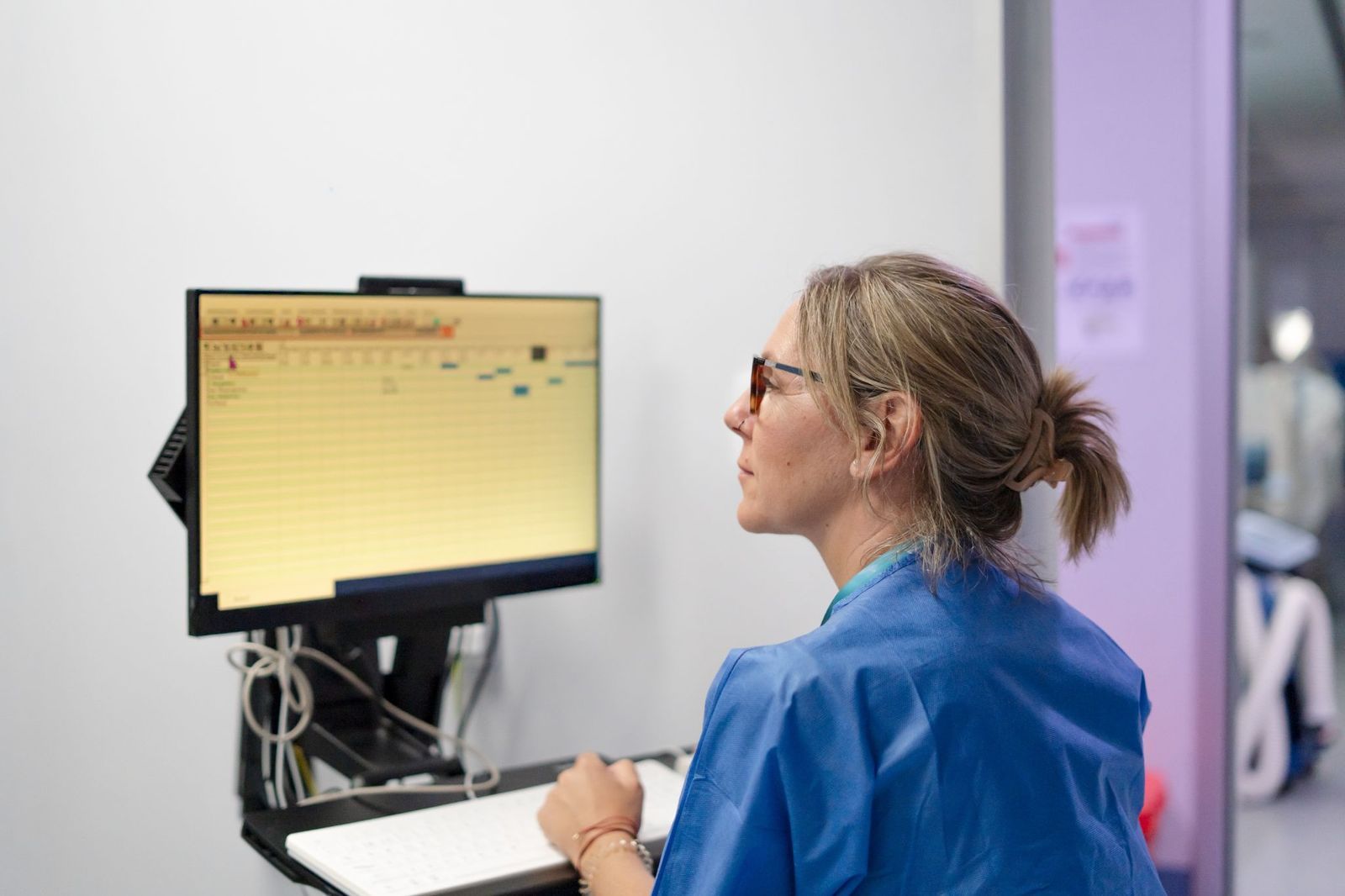
Not all codes are for patients. The next time you’re in a hospital, look closely at what the nurse is pushing from room to room. It may look like a small rolling desk with a computer on top. Staff often call it a "WOW," short for "workstation on wheels."

As hospitals switched from paper charts to electronic medical records, these mobile computers became essential. Nurses use them to review test results, scan medications, update patient charts, and check doctors’ orders without leaving the bedside. The name sounds funny, but the technology helps caregivers spend more time with patients instead of walking back and forth to a nursing station.

9

Sharp container

Image: NMK-Studio

After getting a shot or having blood drawn, most patients never think about where the used needle ends up. It certainly doesn't go into an ordinary trash can.

Hospitals place needles, scalpels, and other sharp medical instruments into special containers designed to prevent accidental injuries. These sturdy, puncture-resistant boxes are sealed when full and safely disposed of in accordance with strict health regulations. This not only protects nurses, but it also protects cleaning crews, waste handlers, and even the public from dangerous needle sticks. It’s one of the most important safety measures in every hospital, even though most patients never notice it.

10

B-52

Image: Photoroyalty

If you’ve ever watched a medical drama, you've probably seen a patient become so agitated that several staff members rush into the room. In situations like that, a doctor or nurse may ask for a "B-52." But the name has nothing to do with numbers themselves; it actually comes from a medicine.

B-52 is hospital slang for a fast-acting injection used to calm down patients who are severely combative or at risk of harming themselves or others. The nickname comes from a commonly used combination of medications that usually include diphenhydramine, haloperidol, and lorazepam. It’s strictly reserved for when other methods of calming the patient haven’t worked.

Looking for an extra scoop of literary fun?

Learn more with our Word of the day

fledgling

/ˈflɛdʒlɪŋ/