BEYOND THE SCRIPT

Ten actors who totally lost themselves in their roles


Published on December 24, 2024


Image: Avel Chuklanov

Sometimes actors take their jobs very seriously, even perhaps too seriously, going above and beyond the requirements of their role. Long after the cameras stopped rolling, these performers might still refuse to break character in order to be able to bring a sense of authenticity to the silver screen.

From committed method actors to those who just can't seem to shake off their on-screen personas, here are ten actors who took their performances to the extreme.

1

Jim Carrey as Andy Kaufman

Image: Noemi Nuñez, CC BY-SA 2.0

In "Man on the Moon," the 1999 biopic on eccentric comedian Andy Kaufman, Jim Carrey portrayed the titular role with such commitment to the part that, to the amusement (and mild annoyance) of everyone on set, he found he couldn’t quite shake the character off even long after the cameras stopped rolling. The immersive experience marked the actor so deeply that, on many occasions, he referred to "knowing" Kaufman, despite never having met him while still alive.

2

Johnny Depp as Jack Sparrow

Image: Harald Krichel, CC BY-SA 3.0

Johnny Depp is another actor famous for always taking his commitment to the role a bit too far, and his portrayal of Captain Jack Sparrow was no exception.

In fact, the Sparrow persona blended so perfectly with his own personality that other cast members found it difficult to tell Depp’s acting from his being serious. One of his former security guards claimed that even outside of the set, he was "basically Jack Sparrow all the time."

3

Sacha Baron Cohen as Borat Sagdiyev

Image: teh_defiance, CC BY-SA 2.0

To the chagrin of everyone involved - unwillingly, more often than not - in one of his many eccentric skits, Sacha Baron Cohen's portrayal of the bumbling and politically incorrect journalist Borat is mind-bogglingly intense. His immersive acting has a purpose though, and that is to catch people off guard and induce them to act in a genuine manner.

However, as his humor often treads dangerously close to the edge of social acceptability, Baron Cohen has confessed that another reason he never breaks character is because things can go very wrong if the thin veil of disbelief is lifted, "someone might even call the police."

4

Anne Hathaway as Fantine

Image: Mingle Media TV, CC BY-SA 2.0

In "Les Misérables," Anne Hathaway gives a haunting portrayal of Fantine, a poor factory worker forced into desperate means to support her daughter. Hathaway took the role perhaps too seriously, as she cut off all of her hair and embarked on a "starvation" diet that led her to lose a ton of weight.

To make matters worse, she reportedly had an identity crisis during filming, likely exacerbated by the demanding transformation process she underwent for the movie.

5

Leonardo DiCaprio as Calvin Candie

Image: LallaBLove, CC BY 4.0

In Quentin Tarantino's "Django Unchained," Leonardo DiCaprio took on the role of Calvin Candie, a ruthless plantation owner. Well-known for his painstaking dedication to his craft, DiCaprio fully embraced the sinister persona of Candie, reportedly even holding back real pain when he cut his hand with broken glass during a particularly emotionally charged scene.

Of course, the director Quentin Tarantino kept the broken glass take in the movie, making the portrayal of this terrifying character even more chilling.

6

Viggo Mortensen as Aragorn

Image: Ivan Gonzalez from Badalona, España, CC BY 2.0

In Peter Jackson's "The Lord of the Rings" trilogy, Viggo Mortensen portrayed Aragorn, the reluctant hero and rightful heir to the throne of Gondor. Although he was not the first pick for the role, both the director and producers felt he was perfect for the role as soon as he arrived on set.

Mortensen's commitment went beyond mere acting; he learned to speak Elvish, trained in sword fighting, hiked to some of the film's most remote locations, and performed many of his own stunts, even though most of this was not actually required to play the part.

7

Kate Winslet as Hanna Schmitz

Image: Andrea Raffin, CC BY-SA 3.0

In "The Reader," Kate Winslet delivered a powerful performance as Hanna Schmitz, a former Nazi prison guard with a dark secret. Winslet immersed herself in the complexities of her character, capturing both Hanna's own vulnerability and her capacity for cruelty.

To pull off a perfect German accent, she kept talking like her character even behind cameras, to the point where her children regularly complained and asked her to stop making "funny voices."

8

Daniel Day-Lewis as Bill the Butcher

Image: Siebbi, CC BY 3.0

In Martin Scorsese's "Gangs of New York," Daniel Day-Lewis delivered a tour de force performance as Bill the Butcher, a ruthless gang leader in 19th-century New York City. One of the most acclaimed method actors in the world, Day-Lewis reportedly spent months researching the time period and even learned how to speak in a 19th-century New York accent.

He was so committed to authenticity that he refused to wear anything else than his period-accurate - and not very toasty - clothes while filming in the midst of winter, leading him to contract pneumonia, for which he also refused treatment with modern medicine. Later, he said that taking these risks is important for his process and that he considers it sort of an "occupational hazard."

9

Christian Bale as Trevor Reznik

Image: Lance Cpl. Hope Straley, Public domain

In "The Machinist," Christian Bale underwent a shocking physical transformation to portray Trevor Reznik, an insomniac factory worker plagued by guilt and paranoia. Bale famously lost over 60 pounds for the role, reducing himself to a skeletal figure.

To achieve this, his diet reportedly consisted of only an apple, water, coffee, and the occasional whiskey, equivalent to roughly 100 calories per day. His intense commitment to the character's downward spiral into madness is evident in every haunting scene, making "The Machinist" a visceral and unforgettable cinematic experience.

10

Hilary Swank as Maggie Fitzgerald

Image: Dick Thomas Johnson, CC BY 2.0

Hilary Swank earned an Academy Award for Best Actress for her magnetic portrayal of Maggie Fitzgerald, a young woman who defies all odds to pursue her dream of becoming a professional boxer.

To fit into the part, she trained just like an aspiring professional boxer would, gaining nearly 20 pounds of muscle in the process. Swank was so immersed in the role that she didn’t notice a blister on her foot developing into a dangerous staph infection that required immediate medical intervention.
The real origins

A house divided against itself: 10 famous phrases with biblical roots


Published on December 24, 2024


Image: Everett Collection

We use a lot of set phrases every day without giving much thought to where they came from. But you might be surprised to learn that many of them, even the ones you’d least expect, have biblical roots. Some have survived for centuries with barely a change, while others have taken on surprising new meanings. How does a saying last that long? From "A house divided against itself cannot stand" to "by the skin of your teeth," here are 10 everyday expressions that came straight from the Bible.

1

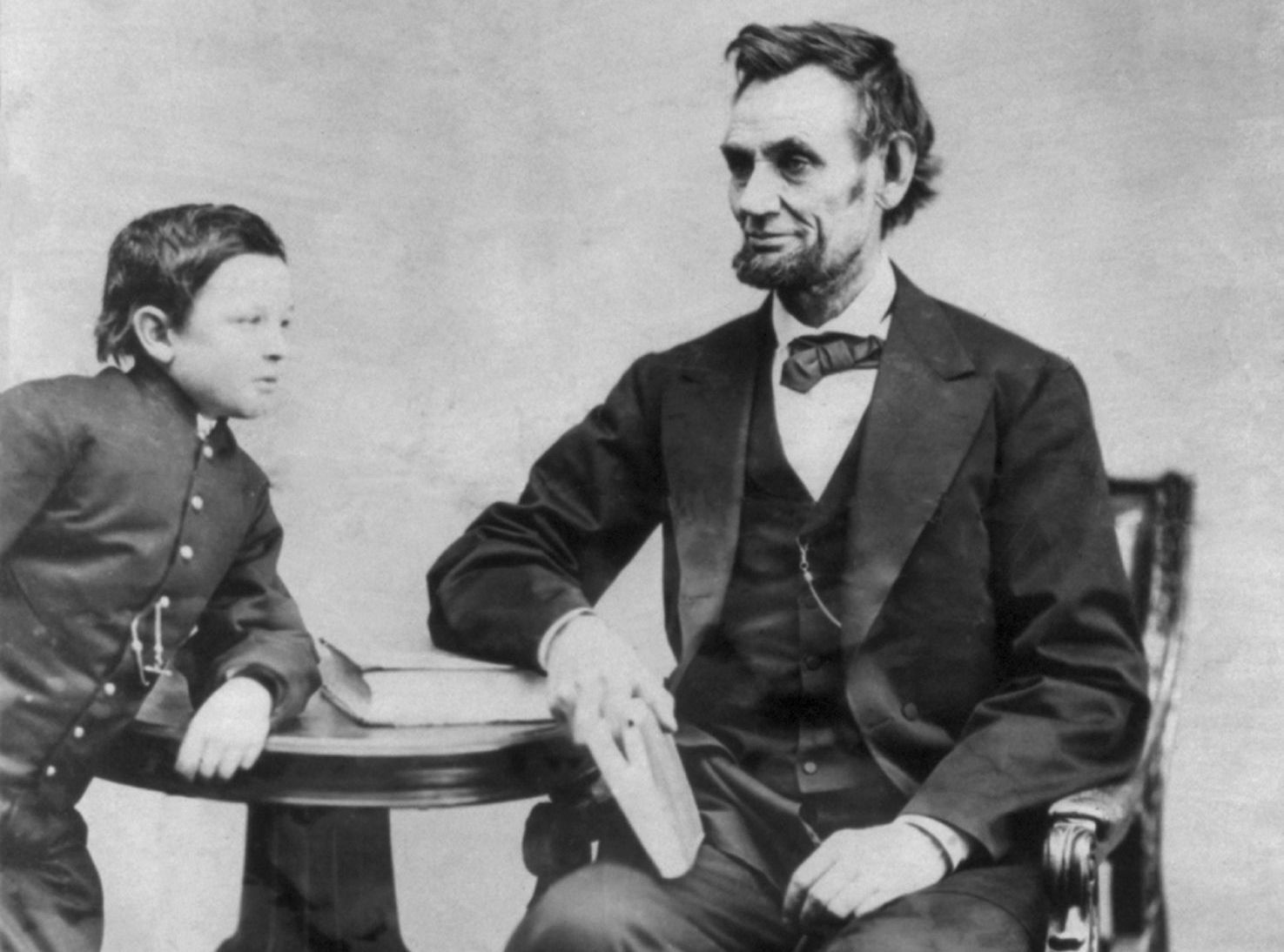
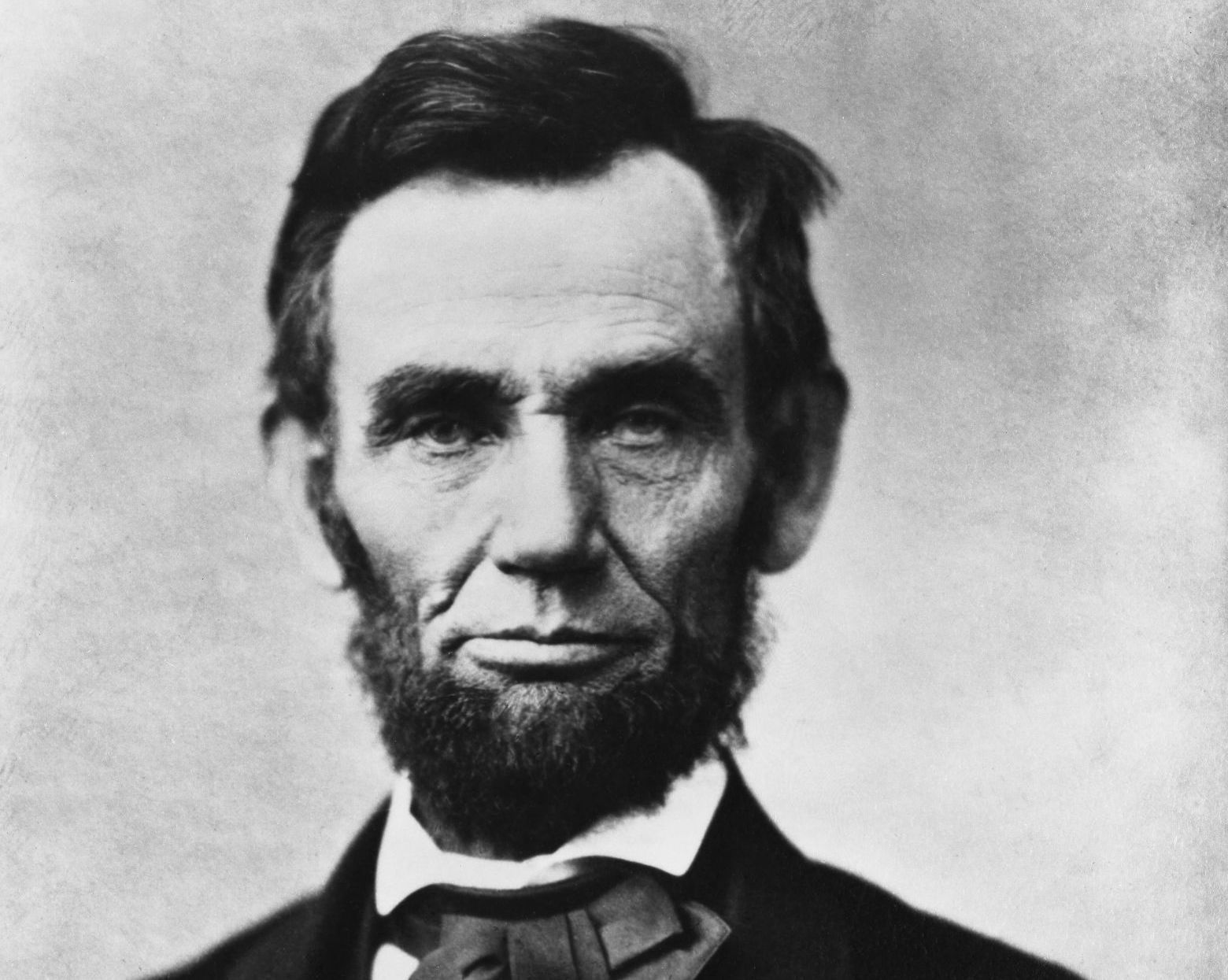
"A house divided against itself cannot stand" (Matthew 12:25, Mark 3:25, and Luke 11:17)

Image: Alexander Gardner, Public domain, via Wikimedia Commons

Most people associate "A house divided against itself cannot stand" with Abraham Lincoln, who used it in a famous 1858 speech while accepting the Republican nomination for US Senate. But the phrase is much older, with roots in the Bible.

It appears three times in the New Testament, used by Jesus to make a point during a dispute. According to the narrative, after he healed a man possessed by a demon, some leaders accused him of using Satan’s power. Jesus turned their argument against them: why would Satan fight his own forces? A kingdom or household divided against itself cannot survive. As English Bible translations spread, biblical expressions entered everyday speech. By the 1700s, this phrase was being used to describe feuding families, struggling businesses, and divided political groups, even before Lincoln made it famous in American history.

2

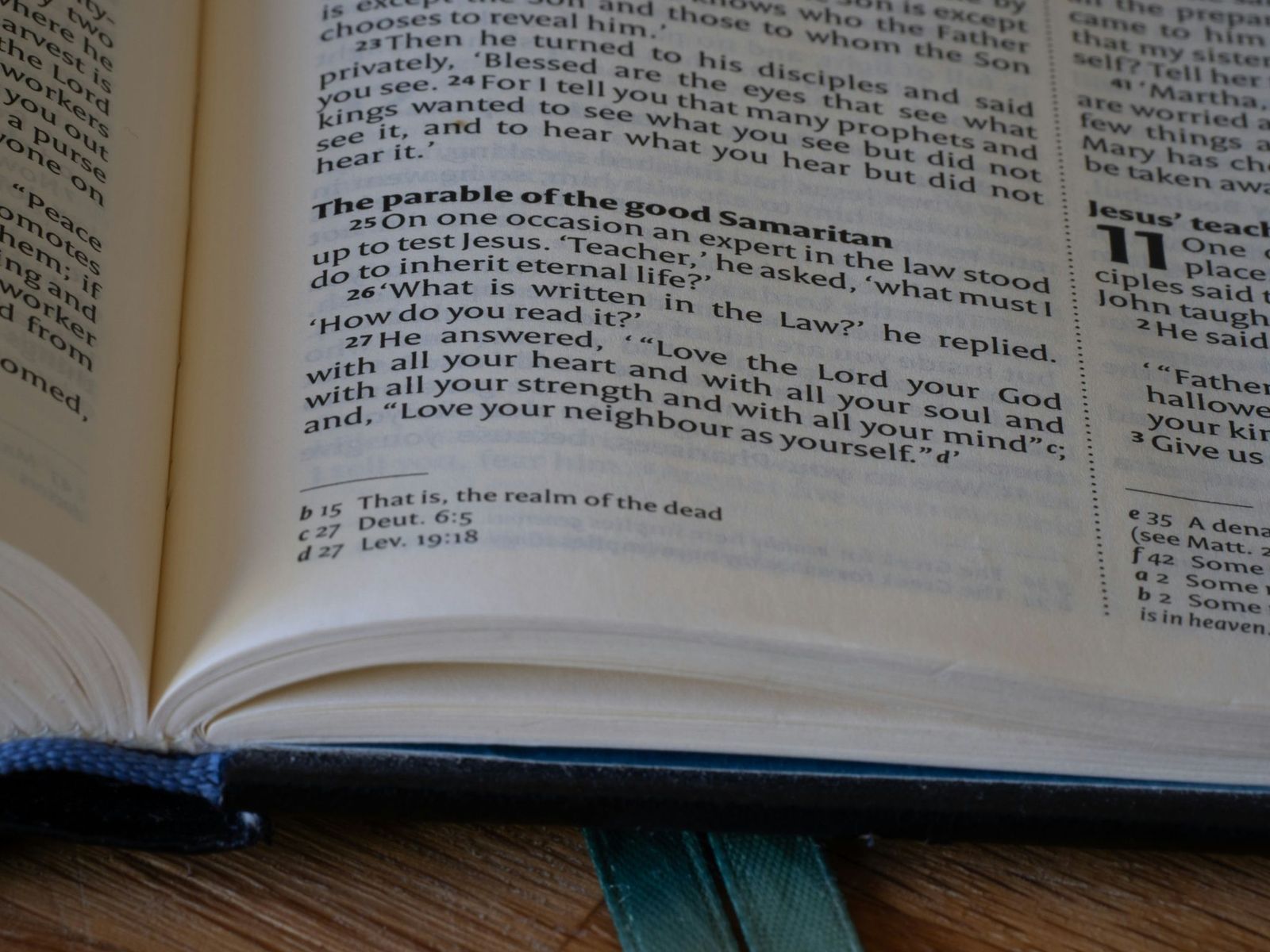
"Good Samaritan" (Luke 10:25–37)

Image: Brett Jordan

When someone stops to help a stranger in trouble, we call them a "Good Samaritan." It’s an everyday expression, but few know it comes from a biblical story.

In the Gospel of Luke, Jesus tells of a Jewish traveler who is robbed and beaten, left barely alive by the roadside. Several people pass him without stopping, but a Samaritan, a member of a community that had a long-standing rivalry with the Jews, stops to help and tends to his wounds. The message is clear: kindness can come from and be given to someone you least expect, even someone your own community regards as an outsider. As the story spread through Christian teaching and English Bible translations, "Good Samaritan" gradually entered everyday language. By the mid 1600s, it was becoming an established expression for anyone who goes out of their way to help someone in need.

3

"An eye for an eye" (Exodus 21:24, Leviticus 24:20, Deuteronomy 19:21, and Matthew 5:38–39)

Image: v2osk

Today, "an eye for an eye" often sounds like a license to get even, but its original purpose was almost the opposite.

The principle appears in several Old Testament passages and in much older legal codes, including the Code of Hammurabi. Known as lex talionis, it established punishment to match the offense, limiting the kind of endless blood feuds in which one injury could trigger another, and another. Rather than permitting people to take revenge, it set a boundary: no more than the offense deserved. In fact, in the New Testament (Matthew 5:38–39), Jesus criticizes the use of this rule as a justification for personal vengeance. William Tyndale used the wording "an eye for an eye" in his 1526 New Testament version, and the King James Bible helped popularize it. As Bible translations spread, the phrase entered everyday English. Over time, the expression moved from the language of law into everyday speech, where it now reflects an all-too-human urge.

4

"The writing is on the wall" (Daniel 5)

Image: Randy Tarampi

When someone says "the writing is on the wall," they’re warning you that trouble is coming and that it looks hard to avoid, but this everyday expression began with a scene straight out of the Bible.

In the Old Testament, King Belshazzar of Babylon throws a lavish feast and drinks from sacred vessels taken from the Jewish temple. Suddenly, a mysterious hand appears and writes four Aramaic words on the palace wall: Mene, Mene, Tekel, Upharsin. The prophet Daniel interprets the message as a warning that the king’s reign is about to end, and that very night, Babylon falls. In the 1500s, early English writers and theologians used the story as a divine warning to corrupt rulers. By 1720, Jonathan Swift, author of Gulliver's Travels (1726), was using "the handwriting on the wall" as a broader warning of trouble, without relying on the original religious meaning. By the 1800s, the expression had become part of everyday English as a way of saying that the signs are there; you just have to be willing to read them.

5

"Wolf in sheep’s clothing" (Matthew 7:15)

Image: photomaster

A "wolf in sheep’s clothing" is someone who seems harmless or trustworthy but is hiding bad intentions. The expression has kept much of its original meaning for centuries, though it began as a warning about a very specific kind of deceivers.

In Matthew 7:15, Jesus warns his followers about false prophets, saying, "They come to you in sheep’s clothing, but inwardly they are ferocious wolves." The image was strong: a dangerous predator disguised as something gentle. The King James Bible, published in 1611, helped spread the phrase throughout the English-speaking world. During the 1700s and 1800s, writers began applying it to dishonest politicians or deceptive lawyers. By the 19th century, the wolf in sheep’s clothing had moved away from its strictly religious meaning and entered everyday speech as a label for anyone whose friendly appearance hides a less nice side.

6

"Blind leading the blind" (Matthew 15:14)

Image: Standret

Ever had a coworker try to teach you a computer program they barely understand themselves? That’s a perfect example of "the blind leading the blind", and this familiar expression has a long history behind it.

It comes from Matthew 15:14, where Jesus warns about religious leaders who actually don’t follow God: "If the blind lead the blind, both will fall into a pit." The image stuck, and in 1500, Dutch scholar Desiderius Erasmus included the saying in Adagia, his widely read collection of proverbs. By the 1700s, as English Bible translations became more widely read, the biblical expression found its way into everyday language. Writers and playwrights began using it to criticize incompetent politicians, bad doctors, or clueless artists. Over time, its meaning broadened into the phrase we know today: people who don’t know what they’re doing trying to lead others who are just as lost.

7

"The love of money is a root of all kinds of evil" (1 Timothy 6:10)

Image: Artem Svystun

"Money is the root of all evil" is a saying many people attribute to the Bible, but the thing is that’s not quite what the Bible says. The original warning is about the love of money, not money itself; a small change that makes a big difference.

In 1 Timothy 6:10, the apostle Paul says, "The love of money is a root of all kinds of evil," to warn a young pastor named Timothy that the pursuit of wealth could lead people away from their faith and bring them trouble. The target was greed, not the contents of your wallet. By the 14th century, the saying had become a familiar warning against avarice in Catholic preaching and also appeared in Geoffrey Chaucer’s famous The Canterbury Tales (1476-1477). Then, the King James Bible (1611) helped cement the wording in English. As biblical language spread into everyday speech, the original warning gradually lost a few words and some of its nuance. Today, "money is the root of all evil" is often used to criticize not just greed, but money itself and even capitalism.

8

"By the skin of your teeth" (Job 19:20)

Image: Ozkan Guner

Ever made it to the airport just as the gate was closing, or escaped a serious mistake at the very last second? You might say you got away "by the skin of your teeth." It’s a strange expression, though, so where did it come from?

The phrase traces back to the biblical Book of Job, where Job describes his terrible suffering and says in the King James Version, "I have escaped by the skin of my teeth" (Job 19:20). Although scholars still debate the use of "teeth" in this translation, Job, worn down by pain and illness, was describing survival at the very edge of endurance, not a last-second getaway. Over time, writers such as John Milton in Paradise Lost (1667), Charles Dickens in David Copperfield (1849-1850), and Victor Hugo in Les Misérables (1862) helped carry the expression into literature and consequently into everyday speech. By the 19th and 20th centuries, its religious context had faded, leaving us with the meaning we know today: escaping danger or succeeding by the narrowest margin.

9

"The last shall be first" (Matthew 19:30; Matthew 20:16)

Image: Aaron Burden

Imagine a struggling football team pulling off a stunning upset against a longtime champion. When the underdogs are on top, the saying "the last shall be first" seems to fit perfectly. But this familiar expression began with a much more complex idea than an unexpected win.

The phrase comes from the Gospel of Matthew, where Jesus declares, "The last shall be first, and the first shall be last." In an ancient world where wealth, power, and high social standing were often viewed as signs of God's favor, he turned that order upside down. In the Kingdom of God, he taught, the humble and overlooked could be honored above the powerful and privileged. By the 17th century, the saying had also become a familiar way to encourage people facing hard times. And in the 19th and 20th centuries, it took on broader social and political meaning, inspiring people fighting for equality and liberation.

10

"Salt of the earth" (Matthew 5:13)

Image: Royce Fonseca

Got neighbors who are always ready to lend a hand and never expect anything in return? You might call them "the salt of the earth". Today, it’s a warm compliment, but its roots go back directly to the Bible.

In Matthew 5:13, Jesus tells his followers, "You are the salt of the earth: but if the salt have lost his savour, wherewith shall it be salted?" In the first century, salt was highly prized, used to preserve food, treat wounds, mark sacred agreements, and in some places, it even served as a form of payment. So the comparison carried a powerful message: just as salt kept food from spoiling, people should help preserve goodness and integrity in the world. The expression later spread into everyday English, appearing in Geoffrey Chaucer’s The Canterbury Tales in the 14th century. Over time, its religious meaning faded, and by the 19th century, the phrase shifted from urging people to live with integrity to describing those who do.

Looking for an extra scoop of literary fun?

Learn more with our Word of the day

exhilarate

/ɪɡˈzɪləˌreɪt/