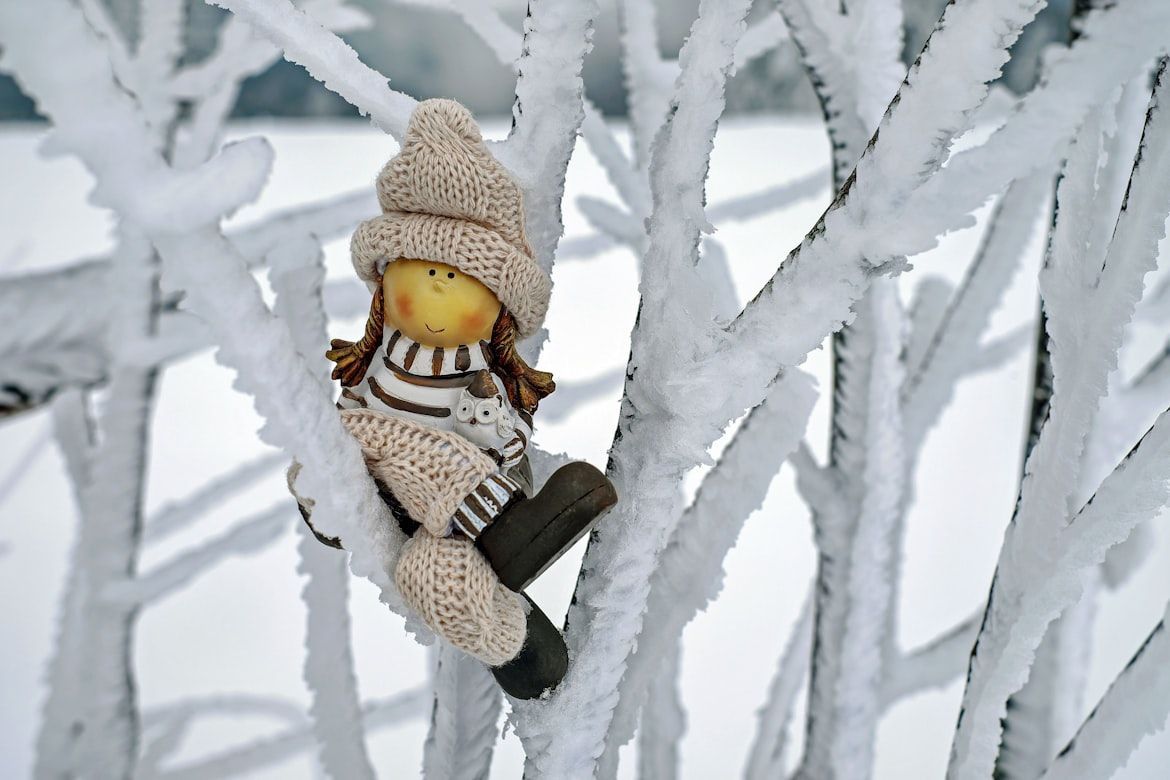
Snowy sayings

You won't believe the real roots of 10 winter idioms you use every day!


Published on March 11, 2026


Image: Aaron Burden

You might not realize it, but the world around us shapes the way we speak. And the seasons are no exception. Have you ever wondered why we say someone is "snowed under" or that they suddenly get "cold feet"? These expressions aren’t random. Today, we’re exploring the origins and meanings of 10 popular winter idioms.

1

Cold feet

Image: Tristan Hess

You’ve thought it through, made your decision, and planned everything. But then nerves take over, and you hesitate. That’s when we say you’re getting "cold feet," and it’s something we’ve all felt at some point.

The expression comes from Germany, though its exact origins are debated. One theory comes from war, describing soldiers ready to fight but unable to charge because their feet were frozen. Another comes from a 19th-century German novel, where a poker player backs out of a game before losing, claiming he couldn’t focus because of his "cold feet."

2

Walk on thin ice

Image: Pix Tresa

If you’ve ever been in a risky situation where a small mistake could lead to disaster, you might say you’ve "walked on thin ice," even if you’ve never been near snow.

The phrase originally described the real danger of walking on thin ice over water in frozen regions. By the mid-19th century, it became a metaphor, used to describe any situation where one is in danger.

3

Give someone the cold shoulder

Image: Obie Fernandez

If your friend ignores your calls or says they won’t be home when you plan to visit, they might be giving you the "cold shoulder." One of the most widely accepted origins of this idiom comes from the Middle Ages. Back then, if an unwelcome guest arrived, hosts couldn’t just shut the door. Instead, they would serve a cold shoulder of beef, mutton, or lamb, instead of a warm, welcoming meal. Unbelievable!

4

A snowball’s chance in hell

Image: benjamin lehman

If you applied for a job that’s completely unrelated to your experience and you’re totally unprepared, we might say your odds are "a snowball’s chance in hell." This idiom, used to express extreme improbability or near-impossibility, emerged in the United States around the 1880s. One of its earliest recorded uses appeared in The Detroit Free Press, describing the slim prospects of a political candidate.

5

Put something on ice

Image: Scott Rodgerson

If you’re working on a project but your creativity is running low and progress stops, it might be time to "put it on ice." This popular idiom simply means to pause something or set it aside for a while. Its origins are quite literal: before modern refrigerators, people stored food with blocks of ice to preserve it for later use.

6

Tip of the iceberg

Image: Spitfire Photography

Imagine your friend is telling you about all the problems they’re facing. You’re shocked by what’s already happened, and then they say, "Wait, that’s just the tip of the iceberg." Oh no! This means things will get even worse.

The idiom is used metaphorically to describe a small, visible part of a larger, hidden problem. But what’s especially interesting is its root: while the exact moment it emerged is unknown, it’s believed to have gained popularity in the first half of the 20th century, shortly after the famous sinking of the Titanic.

7

When hell freezes over

Image: David Tovar

If "a snowball’s chance in hell" means that something is extremely unlikely, then "when hell freezes over" goes even further, indicating absolute impossibility.

The phrase imagines the logical absurdity of a vast place that is completely on fire, suddenly freezing over. It first emerged in the late 19th century, and according to written records, its popularity grew around the 1920s, becoming a widely recognized idiom in everyday English.

8

Be left out in the cold

Image: Ilona Frey

Do you remember Kevin, the main character in Home Alone? Even though he was inside the house, he was essentially "left out in the cold." But how? The expression is used to describe someone who has been forgotten, excluded, or ignored, just like poor Kevin in the movie.

While the exact origins of the phrase are unknown, it likely comes from the literal idea of leaving someone outside, exposed to the cold, without shelter or warmth, highlighting the feeling of being left out.

9

Snowed under

Image: Vitaly Gariev

When work piles up, deadlines loom, and your stress levels rise, we might say you’re "snowed under." This expression, used to describe someone who is overwhelmed, dates back to around 1880. Its origins are literal, referring to the terrible experience of being buried under a heavy snowfall, unable to move, and suffering in the cold.

10

Winter is coming

Image: Andre Taissin

When exam season rolls around, and students face a heavy workload, they might say, "Winter is coming." This expression, used to warn of future challenges, originally refers to the real hardships that winter brings to animals and plants.

Although it has been around for a long time, it gained huge popularity in recent years thanks to the hit TV series Game of Thrones, based on George R.R. Martin’s A Song of Ice and Fire books.


UNSOLVED RIDDLES

10 Mind-Bending Mysteries That Defy All Explanation


Published on March 11, 2026


Image: Marek Piwnicki

Get ready to delve into the realm of the unexplained and unresolved. From eerie disappearances to uncharted phenomena, some of these unsolved mysteries defy logic and will leave us scratching our heads.

In this article, we will explore 10 mind-bending enigmas that continue to elude explanation despite all attempts to elucidate their perplexing nature.

1

The Vanishing Act

Image: Charlie Hales

The infamous Bermuda Triangle, spanning between Miami, Bermuda, and Puerto Rico, is considered by many to be a hot spot for unexplained disappearances of both ships and aircraft since at least 1840. However, despite extensive research, the reasons behind the vanishings remain elusive. Some attribute the apparent phenomenon to magnetic anomalies, while others point to human error or natural explanations.

2

A Cryptic Manuscript

Image: Sohaib Al Kharsa

Dating back to the 15th century, the Voynich Manuscript is a handwritten book filled with bizarre illustrations and an unknown script referred to as Voynichese. Scholars and cryptographers have attempted to decipher its contents for centuries, yet its mysterious language remains uncracked. While some believe it was conceived as a work of fiction or, perhaps, a joke, the manuscript's true origin, purpose, and the meaning of its intricate drawings remain one of history's greatest linguistic conundrums.

3

A Signal from Space

Image: Ben Wicks

In 1977, a radio signal was detected from deep space by Ohio State University's radio telescope. The strange signal lasted 72 seconds and was dubbed the "Wow! Signal" because it bore the expected hallmarks of extraterrestrial origin. But despite numerous attempts, scientists have still been unable to trace its source or explain its origin. The signal's sudden appearance and unique frequency continue to fuel speculation about life beyond the Earth.

4

An Enigmatic Construction

Image: K. Mitch Hodge

The prehistoric monument of Stonehenge, an imposing circle of colossal stones in the middle of a grassy field, has puzzled archaeologists for centuries. The purpose of its construction as well as the exact technology used by its ancient builders - who did not leave written records behind - remain mostly an enigma. However, many researchers have pointed out that the monument could have functioned as a sort of early astronomical observatory.

5

The Somerton Man

Image: Farhan Azam

In 1948, an unidentified man was found peacefully dead on Somerton Beach in Australia. Police found a scrap of paper that read Tamam Shud (meaning "finished" in Persian) in his pocket, later found to be a torn page from Rubaiyat of Omar Khayyam, a 12th-century Persian poetry book. The man's identity, cause of death, and the meaning behind the mysterious phrase remain unknown to this day. A baffling case that could have easily been ripped off the pages of an Agatha Christie book, The Somerton Man continues to mystify investigators, spawning numerous theories but offering no concrete answers.

6

A Bizarre Broadcast Intrusion

Image: Fran Jacquier

In 1987, during two separate incidents, an unknown individual wearing a Max Headroom mask hijacked television broadcasts in Chicago. The bizarre intrusions featured distorted audio and peculiar visuals, leaving viewers bewildered. Following the broadcast intrusion, the Federal Communications Commission (FCC) launched a criminal investigation. However, despite numerous inquiries and widespread speculation over the ensuing decades, the culprits behind the intrusion remain unidentified to this day.

7

The Dyatlov Pass Incident

Image: Hendrik Morkel

In 1959, a group of experienced hikers in the Ural Mountains (then part of the Soviet Union) met a mysterious and tragic end. Their tent was found slashed open, and the hikers were scattered in various states of undress, some with internal injuries. The cause of their deaths and the strange circumstances leading to the incident remain unsolved, with the prevailing secrecy of Soviet authorities at the time further complicating inquiries. The tragic incident has sparked numerous theories, from natural disasters to military experiments, but definitive answers remain elusive.

8

The Taos Hum

Image: Ethan Wright-Magoon

Residents of Taos, New Mexico, have reported a persistent low-frequency hum, known as the "Taos Hum," since the early 1990s. Despite investigations, the source of this mysterious sound, which can only be heard by a small percentage of the population, remains unknown. Similar phenomena have been reported in other parts of the world, leading researchers to believe local sources or even biological auditory effects might be the cause.

9

The Ghost Ship

Image: Jamie Morrison

In 1872, the ship Mary Celeste was discovered adrift in the Atlantic Ocean with its crew mysteriously missing. Surprisingly, the ship was intact, with all its food and valuables untouched. Insurance fraud, mutiny, waterspouts, and giant squid attacks have all been proposed as possible explanations, but no convincing evidence was found to prove any of these theories. Despite exhaustive investigations, the fate of the crew and the reason for their sudden disappearance remain one of maritime history's most enduring enigmas.

10

The Sleeping Sickness Spell

Image: Gregory Pappas

During the early 20th century, a mysterious illness known as Encephalitis lethargica struck half a million people around the world, causing affected individuals to enter a prolonged state of lethargy or sleep. While the exact cause remains unknown, one of the leading theories suggests that brain inflammation triggered by an autoimmune response to a certain strain of bacteria or viral infection could have been responsible for the observed symptoms.

Looking for an extra scoop of literary fun?

Learn more with our Word of the day

alter

/ˈɔltər/