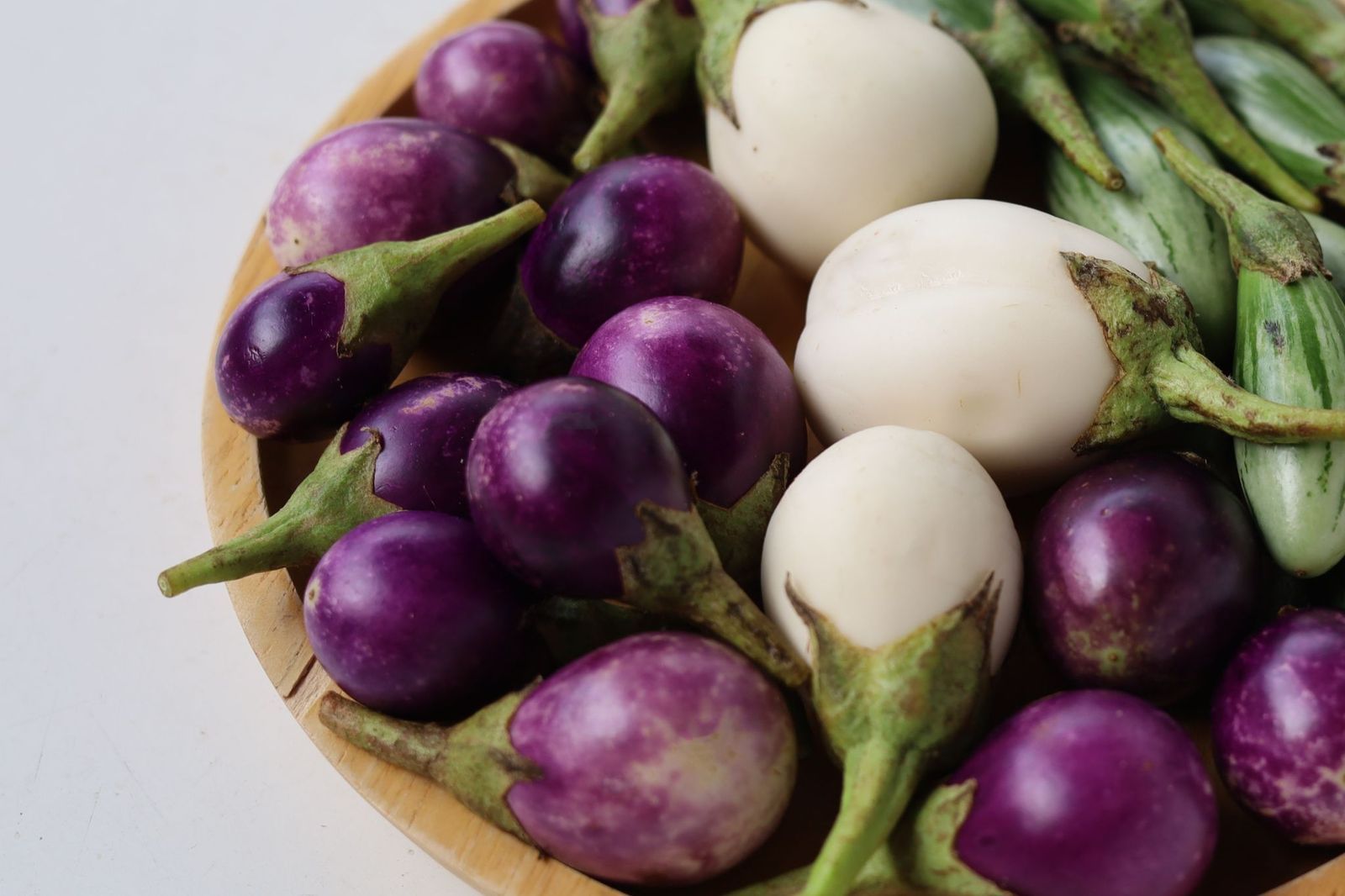
Why do Americans call it "eggplant" while the British say "aubergine"?


Published on October 9, 2026


Image: 9dream studio

Even though we speak the same language as the Brits, walking into a grocery store across the pond can feel like learning a whole new code. Why do we use completely different terms for the exact same thing? Setting aside cooking and recipes, it all comes down to centuries of history, different language roots, immigration, and old trade roots. Here is the fascinating story behind the word origins that drove these transatlantic food names apart.

1

Spring onion vs. scallion

Image: itor

Over centuries of farming trade, these green onions have had different names. In the United States, we use the word scallion, which can be traced back to Old French (escalogne) and Latin (Ascalonius), meaning "onion of Ascalon", an ancient port city in the Levant (modern-day Israel) famous for growing this vegetable.

The preferred British term, in contrast, is a straightforward description based on the time of year (spring) when these young onions are harvested.

2

Banger vs. sausage

Image: Pixel-Shot

The general term sausage is rooted in the Latin salsus ("salted"), entering English via the Old French saucisse to describe minced meat preserved in casings.

The British colloquialism banger, however, is a 20th-century linguistic creation. Originating during the meat shortages of World War I, pork links were stretched with water, cereal, and starches. When placed into a hot frying pan, the trapped internal moisture turned to steam, causing the casings to rupture with a popping sound. The resulting noise gave rise to the moniker "bangers".

3

Biscuit vs. cookie

Image: Marcia Salido

The history of baked goods reflects centuries of trade and travel around the world. The word biscuit comes from the Latin bis cactus (meaning "twice-cooked"). It passed through Old French as the word we use today to describe hard-baked items made to last on long ocean voyages.

The word cookie came to America through early Dutch settlers in New Netherlands (now New York). It stems from the Dutch word koekje, a diminutive version of koek ("cake"). In brief, British English kept the Latin-based term for dry baked snacks, and American English adopted the Dutch word to describe a treat similar to a small cake.

4

Aubergine vs. eggplant

Image: Bowonpat Sakaew

Used in British English, the word aubergine was adopted from French, which inherited the term from the Catalan albergínia. This European form can be traced back through the Arabic al-bāḏinjān, which itself borrows from the ancient Persian bādengān and ultimately the Sanskrit vāti-maṅga. The plant itself is native to southern or eastern Asia, so it’s no surprise that the word has undergone a linguistic journey rooted in the East.

But in the United States, we use the term eggplant instead, which emerged in the 18th century because early European varieties imported to America looked remarkably similar in color, size, and shape to white or yellow goose eggs.

5

Gammon vs. ham

Image: hlphoto

While both words designate cured cuts from the hind leg of a pig, their historical roots reflect different aspects of Germanic and Romance vocabulary development in medieval Europe. Ham is a direct inheritance from Old English hamm, which originally referred not to the meat itself, but to the hollow or bend of the knee or the thigh of an animal.

Gammon, on the other hand, entered English during the Middle English period via Old French (gamon), deriving from jambe (leg), which traces back to the Late Latin gambum. While American English merged these terms under just "ham", British English kept the etymological distinction between the raw cured cut (gammon) and the finished product.

6

Sprinkles vs. hundreds & thousands

Image: Ermak Oksana

These tiny, colorful sugar decorations used on ice cream and baked goods have completely different names on either side of the Atlantic. In American English they are called sprinkles, a name derived from the verb sprinkle, which traces back to Middle English and Germanic roots meaning to scatter small particles or droplets.

Funnily enough, in Britain they are known as hundreds & thousands, a playful descriptive phrase from the 19th century that refers to the sheer multitude of tiny sugar beads packed together on a treat.

7

Courgette vs. zucchini

Image: Matheus Bertelli

Both terms for this green summer squash share a distant ancestor in the Latin cucurbita ("gourd"), but they took different paths through Romance languages. Americans use zucchini, which comes directly from zucchina, the plural diminutive form of the Italian zucca ("pumpkin or gourd").

The British term courgette arrived via the French language as a diminutive form of courge ("gourd"). Therefore, both words etymologically mean "little gourd", separated only by whether Italian or French traders and loanwords dominated the respective nation’s lexicon.

8

Rocket vs. arugula

Image: Bowonpat Sakaew

Even though this peppery green has different names today, they both come from the same ancient word. Rocket, used in Britain, Australia, and New Zealand, evolved from the French roquette. This French term is a direct descendant of the Latin noun eruca, the ancient name for the plant.

Arugula, on the other hand, entered American English as a loanword from regional Italian dialects (specifically rucola), which is a corruption of the Latin eruca. In the end, despite of sounding very different, both rocket and arugula are phonetic variations of the same ancient Roman botanical term.

9

Chips, fries, or crisps?

Image: MSPT

The term French fries (often shortened to "fries" in the U.S.) refers to the culinary technique of "Frenching"—cutting vegetables into long, thin strips—popularized in American English during the early 20th century.

In British English, fried potato strips are called simply chips, using an existing English word traditionally used for carved pieces of wood or stone. To distinguish thin, bagged potato slices from hot potato chips, in the 20th century the British coined the term crisps, in reference to the adjective describing their brittle texture.

10

Coriander vs. cilantro

Image: New Africa

What people call this plant actually depends on whether they mean the seeds or the green leaves. The word coriander has ancient roots, entering English via Old French from the Latin coriandrum, which was borrowed from the Greek koriannon. Interestingly, linguists trace the Greek root back to koris (a bug), likely a reference to the pungent aroma of the fresh leaves.

Cilantro, used in American English specifically for the leaves, is the Spanish word for the plant, derived from the same Latin root (coriandrum).


SHOW ME THE WORDS!

Money Talks: Become A Savvy Investor With These 12 Financial Terms!


Published on October 9, 2026


Image: Micheile Henderson

Few things are as paramount in the world of finance and wealth management as confidence. Mastering the lingo is key not just for knowing your way around business but also for projecting a strong, solid image to the rest of the world.

From the grassroots strategy of "bootstrapping" where entrepreneurs manage minimal resources to build their ventures, to the democratized funding power of "crowdfunding", each term holds a distinct significance in the financial lexicon. So, buckle up for a journey through the terminology that powers business conversations.

1

Bootstrapping

Image: Glenn Carstens-Peters

At the very heart of entrepreneurial resilience lies the concept of "bootstrapping," a strategic approach that embodies the spirit of self-sufficiency and resourcefulness. In the financial realm, bootstrapping refers to the method of building a business without relying on external funding or substantial capital injections.

Entrepreneurs, in a metaphorical sense, pull themselves up by their own bootstraps with personal savings and revenue generated by the business to fund their ventures. This approach encourages fiscal responsibility and a sharp prioritization of needs, fostering a lean, efficient operation.

2

Crowdfunding

Image: Scott Graham

The idea of crowdfunding refers to the practice of raising capital by pooling small contributions from a large number of individuals, typically via online platforms. Entrepreneurs, artists, and innovators can present their projects or ideas to a global audience, attracting support from backers who believe in the venture's potential.

Crowdfunding fosters a sense of community engagement and shared ownership. From donation-based crowdfunding to reward-based models where backers receive early access or exclusive perks, and equity crowdfunding that offers a stake in the venture, this diverse approach to fundraising revolutionizes access to capital.

3

Equity

Image: Kenny Eliason

In the context of stocks and businesses, equity represents a shareholder's ownership interest, often expressed as a percentage. Unlike debt, which involves borrowing money, equity involves a direct stake in the entity's assets and earnings.

Equity holders, commonly known as shareholders, participate in the success and failures of the enterprise, standing to gain from profitability and growth but also sharing the burden of losses. This form of financing aligns the interests of investors and business owners, fostering a collaborative pursuit of success.

4

Net income

Image: Austin Distel

"Net income" is the essence of a company's profitability after accounting for all expenses and taxes. Also referred to as "profit" or "earnings," net income serves as the bottom line on a company's income statement, representing the residual amount that remains after deducting costs from total revenue.

It is the true measure of a company's financial health, reflecting its ability to generate profits and sustain operations. Investors carefully look at net income as a key indicator of a firm's performance and potential for growth. A positive net income indicates profitability, while a negative figure signals losses.

5

Return On Investment (ROI)

Image: Markus Winkler

"Return on Investment" (ROI) measures the effectiveness of an investment by quantifying gain or loss in relation to its cost. Expressed as a percentage, ROI provides a clear measure of profitability and efficiency.

The formula, dividing the net gain from an investment by its initial cost, allows investors to gauge the success of their ventures. Positive ROI signifies a profitable endeavor, while a negative value indicates losses. ROI is a versatile tool applied across diverse investment types, from stocks and real estate to business initiatives.

6

Variable Interest Rate

Image: Mathieu Stern

Unlike fixed rates that remain constant throughout the loan term, variable interest rates go up and down in tandem with market conditions. Commonly tied to benchmark rates like the prime rate, variable rates can rise or fall, impacting borrowers' monthly payments.

While borrowers might initially benefit from lower rates, the inherent uncertainty poses a risk as rates can escalate. This dynamic nature allows financial products to adapt to economic changes, offering both opportunities and challenges for borrowers and lenders alike.

7

Venture Capital

Image: Towfiqu Barbhuiya

"Venture Capital" refers to the funding injected into early-stage, high-potential startups by investors known as venture capitalists. These financiers take calculated risks in exchange for an ownership stake in the company, providing vital capital to fuel growth and development.

Venture capital extends beyond mere monetary support; it often involves mentorship and strategic guidance to help new businesses navigate the journey to success. Venture capital serves as a lifeline for visionary entrepreneurs, fostering transformative ideas from the drawing board to the marketplace.

8

Rent to Buy

Image: Tierra Mallorca

A financial arrangement offering a bridge between renting and owning, rent to buy provides individuals the opportunity to acquire assets gradually. In this agreement, commonly applied to real estate or consumer goods, individuals lease the property or item with the option to purchase it at a later date.

A portion of the rent paid is often credited towards the eventual purchase, affording renters the chance to build equity over time. This financial term serves as a flexible pathway for those aspiring to homeownership or ownership of high-value items without an immediate substantial upfront investment.

9

Initial Public Offering (IPO)

Image: PiggyBank

An "Initial Public Offering" (IPO) is a very important milestone in the corporate life cycle, symbolizing a private company's transition into the public domain. In this situation, a company offers its shares to the public for the first time, inviting external investors to become shareholders.

IPOs are typically orchestrated to raise capital for expansion, research, or debt repayment. The process involves meticulous regulatory scrutiny, as the company prepares a prospectus detailing its financials and business model. The debut on the stock market is a moment of validation for the company and an opportunity for investors to partake in its growth.

10

Liquidity

Image: Alexander Mils

"Liquidity" is the ease with which an asset can be bought or sold in the market without significantly affecting its price. Very liquid assets, such as major currencies or blue-chip stocks, have numerous buyers and sellers. Liquidity is vital for investors, providing the flexibility to enter or exit positions quickly.

On the other hand, illiquid assets, like real estate or certain small-cap stocks, may present challenges in finding buyers or sellers promptly. A concept central to risk management, liquidity influences market stability and the ability to meet financial obligations.

11

Gross income

Image: Lukas

"Gross income" represents the total earnings generated by an individual or business before deducting taxes and other expenses. It is useful for evaluating financial performance and estimating tax liabilities.

In personal finance, gross income encapsulates wages, bonuses, and other sources of earnings, forming the basis for budgeting and investment decisions. For businesses, gross income reflects total revenue from goods or services sold, providing insight into the core profitability of operations.

12

Bond

Image: Austin Distel

A "bond" is a debt security that signifies an investor's loan to a governmental body or corporation. Essentially, it is an IOU with fixed interest payments, typically paid semi-annually, and a predetermined maturity date when the principal is returned.

Bonds serve as a cornerstone in diversifying investment portfolios, offering a more stable and predictable income stream compared to equities. They are classified based on their issuers, ranging from government bonds regarded for their low risk to corporate bonds that carry varying degrees of credit risk.

Looking for an extra scoop of literary fun?

Learn more with our Word of the day

iterate

/ˈɪdəˌreɪt/