Medical lingo for dummies
Why do doctors write “Rx” on prescriptions? Medical abbreviations 101
Published on November 25, 2026

Bad handwriting isn't the only challenge in decoding a prescription. A doctor's note can sometimes look like its own language. And, in a way, it is. Medicine has inherited centuries of Latin terminology while adding a modern layer of acronyms that appear everywhere from prescription bottles to hospital monitors. Some are straightforward, but others hide old expressions and unusual histories. Take a look at 12 familiar medical abbreviations and what those letters really mean.
Rx - Prescription

The familiar Rx symbol doesn't simply stand for the English word "prescription." Its best-supported origin is the Latin recipe, an instruction meaning "take." In the days when apothecaries commonly compounded medicines, a physician's prescription was literally a recipe telling the preparer which ingredients to take and combine.
Over time, the abbreviated recipe evolved into forms such as R, Rp, and the familiar Rx.
PRN - Pro Re Nata

Anyone instructed to take medicine "as needed" may encounter the letters PRN. They come from the Latin phrase pro re nata, generally rendered in medical English as "as needed" or "as the situation requires." Instead of ordering a medicine on a rigid schedule, a PRN instruction allows it to be given when the specified need arises.
That doesn't mean "whenever you feel like it," of course: the prescription can still specify a dose and limits on frequency. The expression has also wandered beyond medication orders. American hospitals may refer to "PRN nurses" or other PRN employees who work when needed rather than according to a regular schedule.
BID - Bis In Die

BID looks like an ordinary three-letter acronym, but once again the answer is Latin. It comes from bis in die, meaning "twice in a day," and traditionally tells the patient that a medication is to be taken twice daily. The key word bis means "twice."
BID also begins a pattern that makes several prescription abbreviations suddenly easier to understand. The ending in die stays essentially the same, while the first word indicates how many times something should happen. One caution: "twice daily" should not automatically be interpreted as precisely "every 12 hours" unless that interval is actually specified.
TID - Ter in Die

Once you know BID, TID makes much more sense. It derives from ter in die: "three times in a day." The Latin ter supplies the three, just as bis supplied the two in BID. What can look like arbitrary medical code is actually part of a remarkably orderly linguistic system.
These abbreviations survive from a period when Latin was the international language of educated European medicine. Doctors no longer conduct their everyday business in Latin, but fragments of it remain embedded in medical vocabulary. A modern patient can therefore receive an instruction containing words from a language that has not had native speakers for centuries.
QID - Quater In Die

The sequence continues with QID, from quater in die, meaning four times a day. Put the three together and the old logic becomes visible: bis for twice, ter for three times, and quater for four. Those strings of capital letters are remnants of complete Latin instructions.
There is a serious reason, however, why healthcare organizations have become wary of certain abbreviations. Similar-looking shorthand can be misread. The Joint Commission prohibits QD (quaque die), traditionally meaning "daily," because it can be mistaken for QID, among other risks, and recommends simply writing "daily." Sometimes spelling out a word is safer than preserving tradition.
NPO - Nil Per Os

If you've ever been told not to eat or drink before a procedure, you may have encountered NPO. The letters come from nil per os, traditionally understood as "nothing by mouth." The particularly useful word to decode is os, Latin for "mouth."
That explains another abbreviation patients may see: PO, from per os, means something is given "by mouth." Add nil (nothing), and PO effectively becomes NPO. The phrase may sound cryptic today, but to someone familiar with medical Latin, the instruction was remarkably direct.
STAT - Statim

"Get me those results, stat!" sounds so natural in English that it is easy to forget where the last word came from. Medical STAT derives from the Latin statim, meaning immediately or at once. Unlike PRN or NPO, STAT isn't formed from the initials of several words. It is a shortened version of one.
This is also a case in which medical jargon escaped the hospital. Generations of television doctors barking orders may have helped make "stat" familiar to people who never studied medicine or Latin.
BP - Blood Pressure
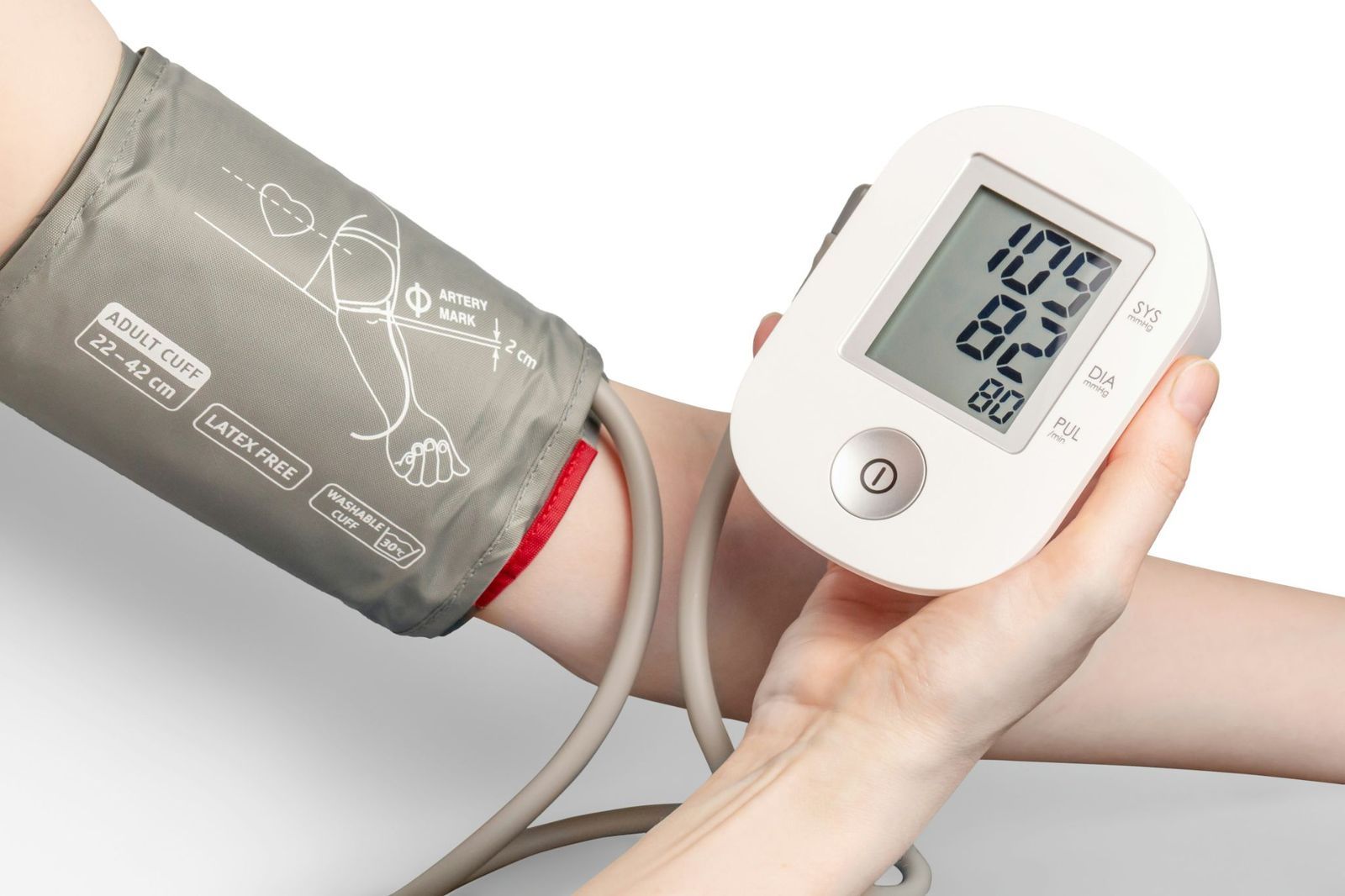
No ancient language is required for BP: it simply means blood pressure. Italian physician Scipione Riva-Rocci introduced his cuff sphygmomanometer in 1896.
Then, in 1905, Russian surgeon Nikolai Korotkoff described the sounds heard through a stethoscope as cuff pressure falls, providing the basis for determining systolic and diastolic pressure by the traditional method. Two tiny letters conceal centuries of experimentation.
HR - Heart Rate

HR is another straightforward abbreviation: heart rate, usually expressed as the number of heartbeats per minute. Once mainly encountered on medical charts and bedside monitors, those two letters have become increasingly familiar as fitness trackers and smartwatches put heart-rate readings directly on people's wrists.
Heart rate and pulse are often used almost interchangeably, but they describe slightly different things. Heart rate counts contractions of the heart, while a pulse is the pressure wave that can be detected in an artery after a contraction. Under some abnormal circumstances, not every heartbeat produces an easily detectable peripheral pulse.
IV - Intravenous

IV stands for intravenous, meaning within or into a vein. The concept has a history stretching back much farther than the plastic bags and tubes hanging beside modern hospital beds. Some of the pioneering experiments took place in Oxford in the 1650s, and involved a man now much better remembered for architecture.
Christopher Wren, who would later design London's St. Paul's Cathedral, participated in early experiments introducing substances into the veins of animals. The equipment was decidedly premodern: historical accounts describe devices involving an animal bladder and a quill. Medicine has changed considerably since then, but the basic idea of delivering something directly into a vein remains recognizable.
OTC - Over The Counter

OTC stands for "over the counter," the familiar designation for medicines that consumers can purchase without a prescription. The FDA also calls them nonprescription medicines, distinguishing them from Rx drugs that require professional prescribing.
The boundary isn't necessarily permanent. Medicines can move from prescription to nonprescription status through what the FDA calls an Rx-to-OTC switch. The agency recognizes both full switches and partial ones, in which a drug remains prescription-only for some uses while becoming nonprescription for others. So Rx and OTC describe regulatory categories that can actually change over time.
BMI - Body Mass Index

BMI stands for body mass index, but the formula behind it is older than the name. Its roots go back to 19th-century Belgian mathematician, astronomer, and statistician Adolphe Quetelet. While studying human characteristics, Quetelet observed a relationship between adult weight and the square of height, producing what became known as the Quetelet Index.
The term "body mass index" arrived much later, through the work of physiologist Ancel Keys and colleagues in 1972. Today BMI is widely used as a screening measure, though it has important limitations and does not directly distinguish body fat from muscle or other lean mass.


