Fancy names for fancy drinks
More than just cool names: learn the meaning of these 10 cocktails’ names
Published on December 30, 2024
 Image: Timothé Durand
Nobody thinks twice about the contents of a drink if the name is Gin & Tonic. But what if you never had a Bloody Mary before, and are offered one? According to history, many popular cocktails were created during the Prohibition era when illegal alcohol was not the most palatable drink, and masking its flavor with other ingredients became a necessity. And, since these concoctions needed an appealing name, creative barmen and barwomen came up with many of the denominations we know today. Featured here are 10 of the most popular ones. Have you tried any of these?
Manhattan
 Image: Johann Trasch
While the real origin of this cocktail consisting of rye, sweet vermouth, and bitters is probably lost to time, the most popular legend is that the Manhattan was specially invented for a banquet hosted by Lady Randolf (mother of Winston) Churchill at the famous Manhattan Club in New York in the late 1800s.
But, when this supposed party took place, Lady Randolph was pregnant with Winston and living in England. So, even if it is a cool story, it is probably not true.
Mint Julep
 Image: Alex Block
These days, it refers almost exclusively to a cocktail of bourbon whiskey flavored with sugar and mint but, the word julep was originally borrowed from French to refer to a sweet-tasting or sweetened drink. Before then, it had Persian roots, and its original pronunciation, "gulab" essentially means sweetened rosewater.
The term was translated to "julab" in classical Arabic and then into Latin as "julapium." Eventually, the word would morph into "julep."
Tom Collins
 Image: Gabriel Gurrola
To explain the origin of the Tom Collins cocktail, we must first introduce his brother, John: A John Collins is a mixture of London dry gin, lemon, sugar, and soda. If you replace the London gin with Old Tom gin, you have prepared a Tom Collins.
The Collins surname of this drink is said to come from a 19th-century headwaiter known as John Collins, who worked at Limmer's Hotel and Coffee House and is thought to be the inventor of the drink. As for the Tom part, its origin is lost to the ages.
Mojito
 Image: Mauro Lima
There are two leading theories as to where the name of the Mojito comes from. The first one holds that the name relates to mojo, a Cuban seasoning made from lime and used to flavor dishes.
Another theory is that the name Mojito is simply a derivative of mojadito, which is a Spanish word for "lightly wet", which would be the diminutive of "mojado" (wet).
Negroni
 Image: Allan Francis
As the legend goes, a certain Count Negroni of Florence, Italy, once requested a drink that would stand apart from all the Americanos ordered at his usual neighborhood cafe.
The bartender answered his request with a cocktail composed of equal parts gin, sweet vermouth, and Campari, and he garnished the result with a telltale orange slice. Unfortunately for the count, the drink became as popular as the Americano, losing the desired exclusivity.
Daiquiri
 Image: Deeliver
This classic cocktail is named after the Cuban village of Daiquirí and, as the story goes, it was invented by local American mining engineers around the time of the Spanish-American War when they ran out of gin and had to use the local rum instead. The cocktail usually consists of sugar, rum, lime juice, and simple syrup.
The daiquiri is identified with revered author Ernest Hemingway, who drank this beverage during his stay in Cuba.
Martini
 Image: Thomas Hetzler
James Bond's drink of choice is typically made with gin or vodka and vermouth. There are many stories about the origin of the cocktail and its name. The bartender professor Jerry Thomas of San Francisco, has claimed that it was invented by a stranger on his way to Martinez, California. Another story says it's named after Martini & Rossi Vermouth, because that brand was first used in the drink Gin and It, with one half gin and one half Martini & Rossi Vermouth.
Another story claims that it was named after a British army rifle, the Martini and Henry, which is known for its kick, like the drink. And the last one, says that it was created at the Knickerbocker Hotel in the early 1900s, by a bartender named Martini di Arma Tiggia that mixed a martini using only a dry gin and dry vermouth.
Margarita
 Image: Luke Bender
The most widely accepted theory about the origin of the Margarita name says that bartender Carlos "Danny" Herrera supposedly thought up this drink around 1938 in Tijuana, Mexico. He created it for Marjorie King, an aspiring actress who he said was allergic to "everything except tequila."
After crafting something for King to drink, Herrera reportedly dubbed the drink margarita, which is a Spanish twist on Marjorie's name.
Old Fashioned
 Image: Bon Vivant
Apparently, in the late 1800s, it became popular to introduce liqueurs into cocktail recipes. And the older, more basic recipes that omitted them, and in particular this classic mix of whiskey and bitters, became known as "old fashioned" cocktails.
People ordering drinks in this fashion wanted to stick to the basics and eventually the modifier "old-fashioned" became the name for this classic cocktail with a lot of variations. The classic version uses a bit of sugar or simple syrup, a splash or two of aromatic bitters, perhaps an ice cube, and rye whiskey.
Bloody Mary
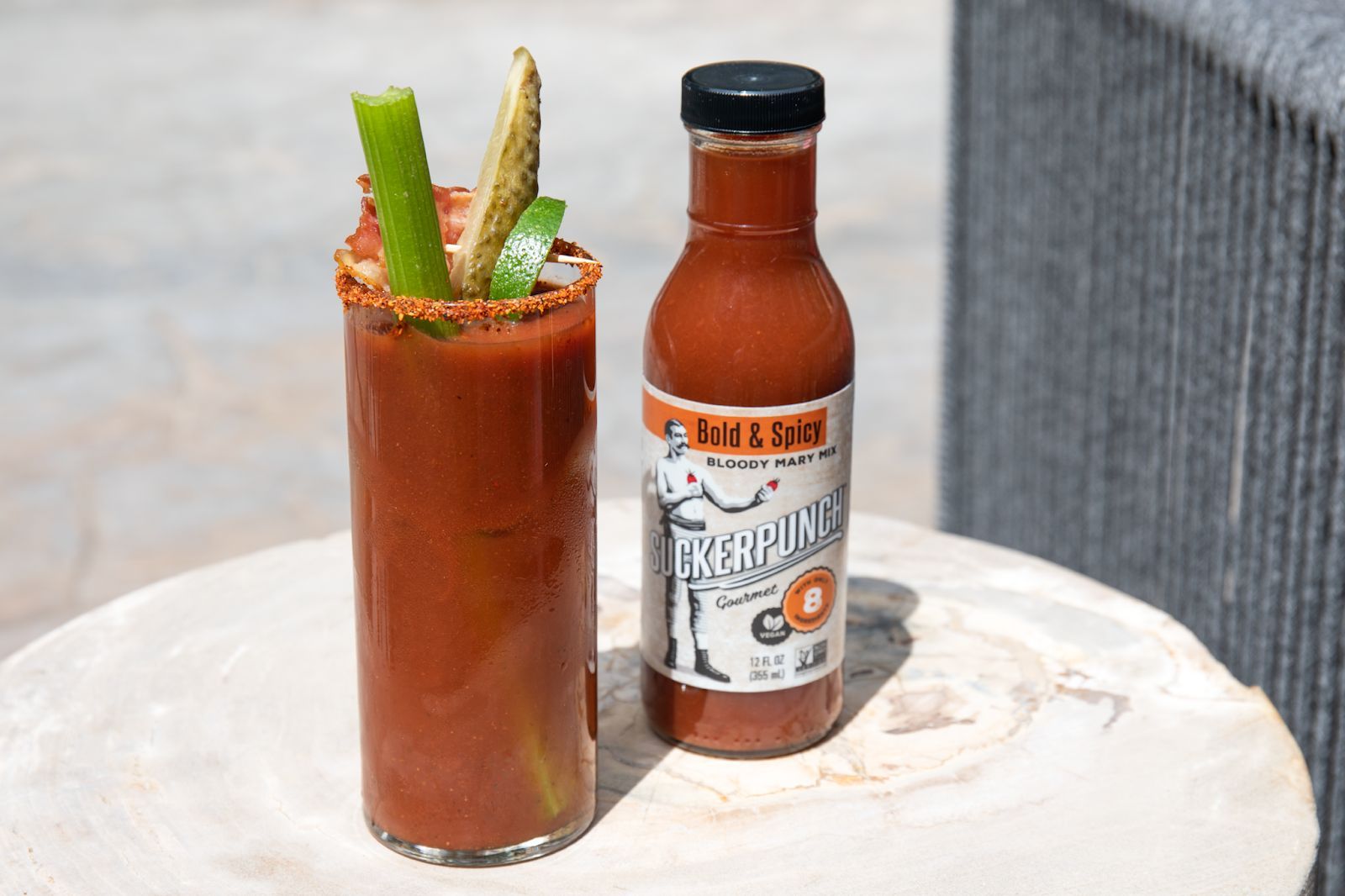 Image: SuckerPunch Gourmet
The most popular tale about this drink’s name links it to the English monarch Mary Tudor, whose nickname was, wait for it, "Bloody Mary", because of how many Protestant heretics she condemned to death.
Another theory suggests that the drink was concocted by a bartender at a Paris bar, where a patron who drank it dubbed it the Bucket of Blood, after a Chicago nightclub, with the name later developing into Bloody Mary.


