Revisiting past misconceptions
History myths debunked: 10 reasons why the Middle Ages weren't dark
Published on April 9, 2025
 Image: Ambrogio Lorenzetti, Public domain, via Wikimedia Commons
Typically, the Middle Ages have carried the stigma of being a time of regression, superstition, ignorance, and barbarism. However, in 1,000 years, there was enough time for great transformations, including key cultural, technological, and scientific breakthroughs. Yes, it was a time marked by conflict, famine, and disease, but many inventions and developments laid the foundations for the modern world. In this article, we’ll discuss why the Middle Ages weren’t as obscure as you might think. Come join us!
Iron tools: An agricultural boom
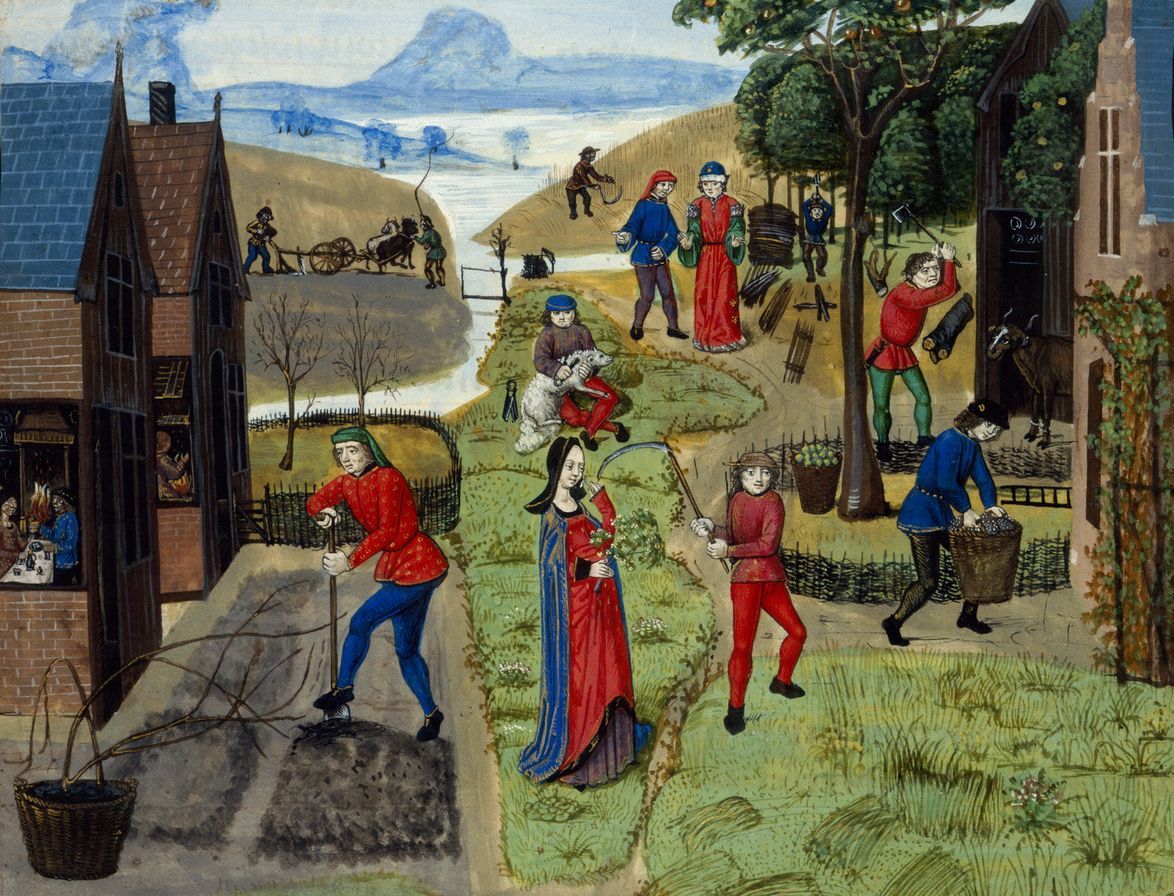 Image: British Library, CC0, via Wikimedia Commons
During the Middle Ages, the West did extremely well thanks to a development in agricultural knowledge. Inventions as elementary as iron tools and the wheelbarrow transformed the medieval agricultural landscape. Their simplicity and efficiency allowed for the reduction of the workload, optimizing resources and boosting the growth of agricultural production.
The feudal system also introduced efficient ways to manage the land. The possibility of carrying materials over greater distances, the expansion of arable areas, and the introduction of new agricultural practices resulted in more food, better nutrition, and an increase in population. This shows that even the simplest innovations can bring about profound changes in society!
Printing press: The democratization of knowledge
 Image: Rijksmuseum, CC0, via Wikimedia Commons
The advent of the printing press marked a turning point in history. It was invented by Johannes Gutenberg around 1440 and was the key to producing books quickly and massively, breaking down the barriers of cost and accessibility. This, in turn, gave way to the democratization of knowledge, later boosting the Renaissance intellectual movement.
Since the Middle Ages, this technique became the perfect vehicle for wider access to essential texts, fostered the exchange of ideas and debate, and promoted cultural flourishing, paving the way for the Scientific Revolution and the Enlightenment, decisive stages in the world's social development.
Public libraries: Access for all
 Image: Henry Be
Once the printing press was invented, the next step was to make books available to the entire population. The creation of libraries during the Middle Ages was essential to widespread new ideas. The world's first public library, located in Cesena, Italy, was inaugurated in 1452. This library allowed citizens free access to its collection of books.
At a time when learning and literacy were largely restricted to the clergy, the Cesena Library offered the population unprecedented access to knowledge. This symbolizes a change in the social perception of the importance of education, which began to be seen as a common good. The Cesena library became a model for future public libraries, promoting the idea that knowledge should be accessible to all.
Universities: The birth of higher education
 Image: [1], Public domain, via Wikimedia Commons
Between the mid-twelfth and early thirteenth centuries, all of Europe began to develop new institutions of education: the universities. These learning centers, which taught the arts, law, medicine, and theology, would forever change the intellectual and social landscape of the continent.
The medieval universities were based primarily on the Classical structure of ancient Greek education. However, they were also heavily influenced by Islamic education, which was thriving at the time. The University of Bologna, founded in 1088 in Italy, was the first ever to grant degrees. It was followed by the University of Oxford, founded in 1163.
The astrolabe: A revolution in astronomy and navigation
 Image: padrinan
The astrolabe is one of the most fascinating inventions of the Middle Ages. Although the Greek astronomer Claudius Ptolemy is known to have used a similar instrument, it was during the Middle Ages when the astrolabe reached its maximum sophistication, allowing navigators and astronomers to expand their horizons, overcoming the geographical barriers of the time.
This medieval scientific advance helped to measure celestial bodies' altitude, making navigation easier. The astrolabe favored interaction between peoples and contributed to the flourishing of trade and culture. The expansion of maritime routes not only increased the wealth of medieval societies, it also laid the foundations for commercial globalization in the centuries to come.
Buttons: Improving everyday life
 Image: British Library, CC0, via Wikimedia Commons
At first glance, it may seem inconsequential, but the introduction of functional buttons in the Middle Ages meant a considerable improvement in everyday life. Before the 13th century, buttons were purely decorative, with no practical purpose. The invention of buttonholes allowed buttons to become truly useful, allowing clothes to fit more securely.
The use of functional buttons led to more elaborate and fitted garments, providing comfort and freedom of movement. This innovation had a cultural impact, as buttons acquired a symbolic and aesthetic status. Their production demanded technical skills, raising craftsmen's prestige and establishing a new market. This phenomenon reflects how small innovations can have an expansive effect on society, ranging from culture to the economy.
Eyeglasses: Vision problems are a thing of the past
 Image: Vassil, Public domain, via Wikimedia Commons
Eyeglasses were one of the most significant inventions of the Middle Ages, improving the quality of life for those suffering from vision problems. Although convex lenses had been used before, the first spectacles appeared in Italy during the 13th century.
The manufacture of glasses required experimenting with various materials and an advanced knowledge of optics, marking the birth of modern optometry. This breakthrough made life easier for monks, scholars, and craftsmen who depended on sharp vision. Through improved quality of life and productivity, this medieval invention directly impacted the economic and cultural growth of society.
Knowledge goes East: The Byzantine golden age
 Image: robynstewart
The Middle Ages weren’t as dark as Renaissance and Enlightenment artists liked to think. Knowledge had simply migrated to the East, first to Constantinople and then to the Islamic world. Many scientific treatises that were recovered during the Renaissance came, in fact, from copies made in the East during this time.
The Byzantine Empire, for example, was a massive outpouring of books. Literacy was high, elementary education was widespread —even in rural areas— and middle and higher education were available to many people. While the Byzantine Empire didn't create a lot of new thinking, it solidified and protected invaluable knowledge for the future.
The hourglass: Measuring time more efficiently
 Image: Towfiqu barbhuiya
The hourglass, adopted in Europe towards the end of the High Middle Ages, became a key tool for measuring time accurately. Its simplicity and reliability were fundamental in an era when the management of daily activities was increasingly valued.
This instrument is one of the medieval inventions that most favored navigation and trade, boosting cultural and economic exchange. The portability and precision of the hourglass made it an essential resource for sailors, as it was unaffected by the ship’s movement, ensuring accurate timekeeping. The appreciation of time as a valuable resource laid the foundation for the development of more advanced clocks, spurring technical progress over the following centuries.
Paper money: First steps for a modern financial system
 Image: J. Bognard, Public domain, via Wikimedia Commons
Paper money is the medieval invention that revolutionized the economy the most. Originating in China in the 11th century, it did not reach Europe until several centuries later. However, its introduction made it possible to replace heavy metal coins with light banknotes, simplifying commercial transactions.
Its adoption in Europe meant a radical transformation in financial structures and in the way capital circulated. The convenience of transporting and storing paper money boosted trade, expanded markets, favored economic growth, and sowed the seeds of the modern financial system.


