Tickled pink to read this

Here's a golden opportunity for you to read about 10 iconic songs!


Published on March 9, 2026

Image: Tim Mossholder

Songs stick with us for all sorts of reasons, but when a song has a splash of color in the title, it seems to carry an extra punch, don’t you agree? Colors spark emotion, trigger memories, and even make a song easier to remember. Over the years, musicians have leaned on shades of black, blue, yellow, and more to give their hits an edge. Let’s take a walk through some memorable tracks where a color in the title helped turn music into something timeless.

1

Purple Rain

Image: Wang Yifang

Of course, this one was going to be the first item in our article. When Prince released "Purple Rain" in 1984, he turned a color into a feeling. Purple came to represent spirituality, passion, and mystery, while rain symbolized both sorrow and hope. The combination gave us one of the most powerful rock ballads of the decade.

2

Blackbird

Image: Nikita Nikitenko

The Beatles’ "Blackbird," released in 1968, may sound gentle, but it was written with powerful meaning. Paul McCartney has said it was inspired by the Civil Rights Movement in the United States. The "blackbird" symbolized hope and resilience. Behind its delicate fingerpicked guitar arrangement, the song carried a quiet strength that continues to inspire listeners today.

3

Brown Eyed Girl

Image: Anastasiia Pyvovarova

Few songs feel as sunny as "Brown Eyed Girl." Released in 1967, it became Van Morrison’s most famous hit. He originally wrote it as "Brown Skinned Girl," but changed it at the last minute. That switch gave us a track that became a staple of radio, backyard parties, and weddings for decades.

4

Paint It Black

Image: Veronica Lorine

The Rolling Stones weren’t afraid to shake things up, and "Paint It Black," released in 1966, proved it. The haunting sitar riff and pounding rhythm gave the track a unique edge. The lyrics, full of grief and darkness, showed that rock music could explore themes far beyond simple love songs. It became an anthem for a restless generation.

5

Yellow

Image: Haoran Wang

Coldplay wasn’t yet a household name when "Yellow" was released in 2000. The simple word gave the song a sense of warmth and light, even though the lyrics focus on love and devotion. The band has said the color choice was almost random, yet it ended up helping to define their early sound and launch their career.

6

Black or White

Image: Joshua Reddekopp

Michael Jackson’s "Black or White," released in 1991, carried a powerful message about race and equality. Its upbeat, guitar-driven sound, paired with pointed lyrics, made it more than just a pop song. Jackson used color in the title to drive home the idea that love and humanity matter more than skin tone.

7

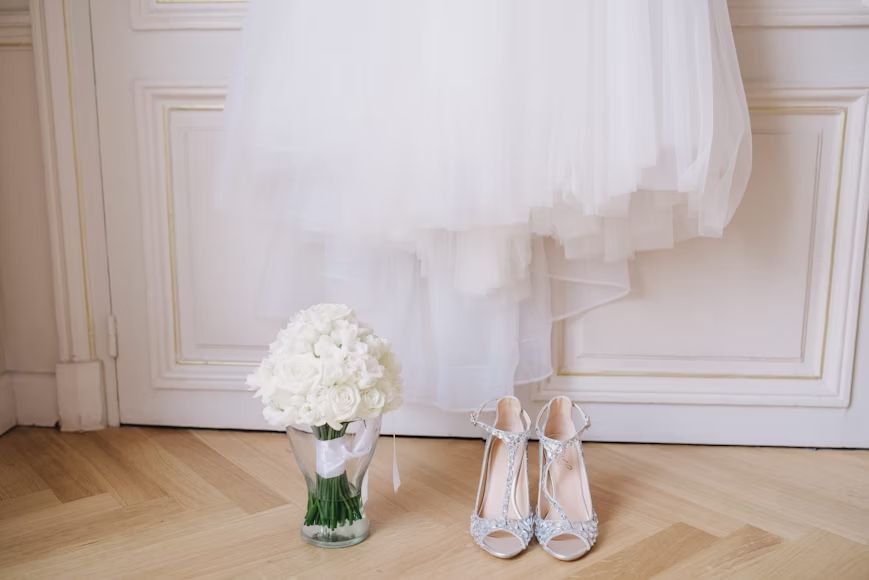
White Wedding

Image: The Now Time

Billy Idol’s "White Wedding," released in 1982, wasn’t your typical love song. In fact, it was more of a mockery of marriage than a celebration of it. Idol has said the track was inspired by watching his sister’s wedding. The color white, traditionally associated with purity, was used with irony and a sharp edge.

8

Blue Suede Shoes

Image: Liana S

Elvis Presley helped make "Blue Suede Shoes" a nationwide hit in 1956, though Carl Perkins wrote and first recorded it. The song showed how even a pair of shoes could be transformed into a rock anthem. Not because of the fashion item, but because Elvis had a magic touch! Protecting those shoes wasn’t really the point; it was about attitude.

9

Fields of Gold

Image: Tory Morrison

Sting released "Fields of Gold" in 1993, and it’s as peaceful as its name. Inspired by the barley fields near his home in England, the golden imagery reflected both love and the passage of time. The song’s warm melody and reflective lyrics helped cement it as one of his most beloved solo works.

Wanna know a fun fact? Paul McCartney once told Sting he wished he had written "Fields of Gold." Sting replied that he wished he had written "Blackbird" — a nod to McCartney’s classic with The Beatles.

10

Back to Black

Image: Lizgrin F

In 2006, Amy Winehouse poured her pain into "Back to Black." The title captured her return to dark times after a breakup. Here, black isn’t about fashion or aesthetic; it symbolizes loss, relapse, and emotional turmoil. Her deep, soulful voice made the song raw and unforgettable, even for listeners who had never heard of her before.


TOYS FROM THE VAULT

What Were Barbies Made For? The Origin of 11 Timeless Toys


Published on March 9, 2026


Image: Super Snapper

Who comes up with toys? From dolls and teddy bears to kites and frisbees, these beloved classics have origin stories filled with creativity, serendipity, and often family games. Over the decades, these toys have influenced several generations of children. How did they come to be? Let’s uncover the tales behind 11 timeless toys that left indelible marks on childhoods all around the world.

1

Play-Doh

Image: LMoonlight

It wasn’t a plaything, at first. The famous modeling putty was created in 1933 by American soap manufacturer Kutol Products for cleaning coal residue from wallpaper. When houses stopped being heated by coal and soot was no longer a housekeeping problem, the company neared bankruptcy.

It was then that the McVicker family, creators of the compound, became aware that a kindergarten teacher was using their coal-cleaning putty to make art projects with the children. Inspired, the McVickers brainstormed names for the new toy. They considered "Rainbow Modeling Compound" and "Play-Doh," ultimately choosing the latter. They launched it in 1956 and became an international success in a matter of 5 years.

2

Teddy bears

Image: Sandy Millar

You might think that teddy bears have been around for centuries, but that’s not the case. The Steiff company, founded in Germany in the 1880s, was the first to popularize plush toys in their country and across Europe. It wasn’t until 1902, however, that these toys became famous in the U.S.

This happened because, simultaneously, toymaker Morris Michtom had patented and released the design of a plushy bear figure. He based the design on a cartoon depicting President Theodore Roosevelt refusing to shoot a small, cute bear. Inspired by this incident, Michtom named the new plush toy "Teddy Bears." His and Steiff’s versions of the toy became widespread in the world. Some years later, in England, author A.A. Milne bought a fuzzy bear for his son and, in 1921, published a series of books inspired by it, called Winnie-the-Pooh.

3

Playmobil

Image: Teo Zac

Large heads, big smiles, and no noses. Did you know that the iconic design of Playmobil’s face was inspired by children’s drawings? In the early 1970s, Hans Beck, a German toymaker, revolutionized the industry with the invention of these small plastic humans. At the request of the owner of the Geobra Brandstätter company, Beck set out to design a toy that would be simple yet engaging, fitting perfectly in a child’s hand.

Beck developed the small figures, which, during the 1973 oil crisis, became a much cheaper and more viable product than larger plastic toys like hula hoops. Launched in 1974, Playmobil was an instant hit, and the brand went on to release accessories like automobiles, cranes, and boats that became just as classic as the main figures.

4

Lego

Image: ta98mori

Lego bricks have to be one of the smartest inventions in the toy world. They were introduced in 1949 by the Danish company Lego Group, today the largest manufacturer in the industry. The company was founded by Ole Kirk Christiansen, a carpenter who started making wooden toys in 1932 under a name inspired by the Danish phrase leg godt, which translates to "play well."

In 1949, the first version of the famous interlocking plastic bricks was released. This version was based on similar existing wooden blocks on the market. Over the years, seeing the inventive potential of these construction toys, the company developed a variety of brick types. Lego bricks soon became a symbol of creativity and free play to the point where they are no longer considered just toys for children but are popular among adults as well.

5

Jenga

Image: Michał Parzuchowski

As simple and brilliant as it is, the first game of Jenga wasn’t played until one family invented it in the 1970s. For 13 years after that, it remained a family tradition. Its creator, Leslie Scott, and her family had once purchased a set of wooden blocks from a sawmill in Takoradi, Ghana. Playing with them, they had come up with an exciting game that followed the rules that we now know as Jenga.

Scott explained that its name is derived from the Swahili word kujenga, which means "to build." She officially introduced Jenga to the world at the London Toy Fair in 1983, and it quickly became a global favorite.

6

Barbies

Image: Sandra Gabriel

It is estimated that two Barbies are sold every second. The world’s most famous doll was introduced in 1959 and remains one of the strongest brands in the toy industry. The concept was created by Ruth Handler, who, along with her husband Elliot, co-founded Mattel in 1945.

Ruth had noticed that their daughter, Barbara, would play with paper dolls and assign them various adult female roles. At the time, most dolls simply represented babies or infants. Combining this vision with the image of a Bild Lilli doll that Ruth had purchased in Europe, the Handlers created the Barbie doll. It became Mattel’s signature product, and the company is today one of the world’s largest toy manufacturers.

7

Frisbee

Image: Shubham Sharan

One evening after a Thanksgiving dinner in 1937, Fred Morrison and his fiancee Lucile started taking turns tossing a popcorn can lid at one another—a form of play that humans have engaged in for ages. That’s why it didn’t strike Morrison as an excellent toy idea, until one day when continuing the game of tossing a cheap pan back and forth on some beach, Fred and Lucile were approached by someone interested in buying the flying object. That was when Fred's lightbulb went off.

Marketing them as "Flyin-Saucers" to ride the wave of interest in unidentified flying objects that surged in the 1940s, Morrison and his partners started selling pan-shaped plastic discs. They eventually sold the rights to Wham-O, the company that changed the product’s name to "Frisbee."

8

Kite

Image: Agnieszka Ziomek

Kites originated in China over 2,000 years ago, but their original uses long preceded their role in park playtime as we know it today. The earliest kites were made of materials like silk and bamboo and were used for various practical purposes, including military communication, measuring distances, performing religious rituals, and testing the wind.

It wasn't until the late 19th and early 20th centuries that kites became widely recognized as recreational toys for both children and adults.

9

Hula hoop

Image: Los Muertos Crew

Of the list, these are certainly the oldest. Hoop-shaped objects have been around since 500 BC and were often used recreationally by both kids and adults. In the mid-20th century, though, bamboo hoops became extremely popular in Australia, where children would use them in playgrounds and around the streets.

In 1957, the company Wham-O (the same one that patented the "Frisbee") became aware of its success in that country. They began manufacturing the hoops in a plastic material and selling them in the U.S. as the "Hula Hoop." They did not invent the name, which had been in use since the 18th century, but they trademarked it, and it became one of their legendary products.

10

Etch-A-Sketch

Image: Klim Musalimov

Etch-A-Sketch, the famous drawing toy, was born by accident. French inventor André Cassagnes, an electrical technician, was writing with a pen on a translucent material when he realized that traces could easily be produced and erased. Based on this, he created a device he named L'Ecran Magique, or "the magic screen." The first version used aluminum powder and glass to create a toy that could be drawn on with a simple stylus, and then shaken clean to start anew.

Later on, the Ohio Art Company saw the idea at a toy fair in 1959, recognized its potential, and rebranded it as the "Etch A Sketch." For many decades, even with the advancement of digital technology, this analog toy remained a timeless classic.

11

Slinky

Image: Adam Valstar

Slinky, the beloved coil toy, was invented by naval engineer Richard James in 1943. He had been working on a project to stabilize equipment on ships when he accidentally knocked one of the springs off a shelf. He watched the spring "walk" instead of falling. That funny image gave him an idea.

Together with his wife Betty, James refined the concept and introduced it as "Slinky" through department stores. They created a toy that was as charming as it was simple, and completely affordable, initially selling for $1. The toy could walk downstairs, stretch, and bounce back, which hooked children and adults. Its timeless appeal has even earned Slinky a place in the National Toy Hall of Fame, and even an eponymous character in the Toy Story franchise.

Looking for an extra scoop of literary fun?

Learn more with our Word of the day

gloomy

/ˈɡlumi/