Timeless leaders
Genghis Khan, Julius Caesar, and more: 10 outstanding military leaders!
Published on March 19, 2025
 Image: Filip Andrejevic
Few aspects of human history are as consistent as warfare. While armed conflicts are undoubtedly regrettable, it’s impossible to deny that they have played a central role in our culture since the dawn of civilization. In that sense, many exceptional military minds and strategists have left their mark on history—to the point that we still discuss their remarkable accomplishments centuries later. With that in mind, we have selected 10 of the most outstanding military minds humankind has ever produced, in an effort to pay homage to their strategic genius. Enjoy!
Napoleon Bonaparte
 Image: Daniel Robert
Few military generals are as iconic as Napoleon Bonaparte. Can’t you instantly picture his emblematic military attire the moment you hear his name? Napoleon's accomplishments are as remarkable as his legacy—he rose to prominence during the French Revolution, led numerous military campaigns across Europe, and eventually ruled the French Empire as Emperor until 1815.
Julius Caesar
 Image: Nemanja Peric
Just like Napoleon, a distinct image of the Roman leader Julius Caesar immediately comes to mind when his name is mentioned—a stoic, unwavering figure, his calculating mind crowned with iconic bay leaves. As a member of the political alliance known as the First Triumvirate, Caesar led Roman armies to victory in the Gallic Wars before clashing with his rival Pompey in a civil war, from which he emerged as the undisputed ruler of Rome until his assassination in 44 BC.
Alexander the Great
 Image: Nikos Vlachos
Many historic leaders have borne the title "the Great," from the aforementioned Pompey to the Prussian monarch Frederick II. However, many historians argue that this distinction belongs above all to Alexander III of Macedon—better known as Alexander the Great. He ascended the throne of Macedon at just 20 years old, and by 30, he had built one of the largest empires in history, stretching from Greece to India.
Genghis Khan
 Image: Patrick Schneider
Genghis Khan is arguably one of the most divisive figures in history. To some historians, he was a ruthless tyrant, while to modern Mongolians, he is revered as the founder of their nation. One thing that cannot be denied, however, is his military genius—he united the Mongol tribes into a single, unstoppable force that conquered vast regions of China and Central Asia.
Sun Tzu
 Image: Kevin Jackson
Who can deny the military genius of the man who considered warfare an art form? Sun Tzu, a general and strategist during the Eastern Zhou period, is best known for writing the timeless military classic The Art of War. But don’t let the title mislead you—Sun Tzu’s insightful and groundbreaking teachings have transcended the battlefield, influencing fields such as business and sports.
George S. Patton
 Image: mbtrama, CC BY 2.0
Let’s jump ahead a few hundred years to the 20th century and pay a well-deserved homage to the first American featured in this article. General George S. Patton is forever remembered for commanding the United States Army during World War II, including the Allied invasion of Germany and subsequent campaigns in France and Germany. Patton is not only celebrated for his military prowess but also for his colorful and resolute personality, which reassured millions of Americans during one of history’s darkest chapters.
Hannibal
 Image: The Cleveland Museum of Art
Following the iconic thriller The Silence of the Lambs, the name Hannibal has taken on a somewhat eerie connotation. Which is a shame, considering it was also borne by a legendary Carthaginian general renowned for his military prowess. Hannibal famously led Carthage’s forces against the Roman Republic, including a daring crossing of the Alps with North African war elephants.
Horatio Nelson
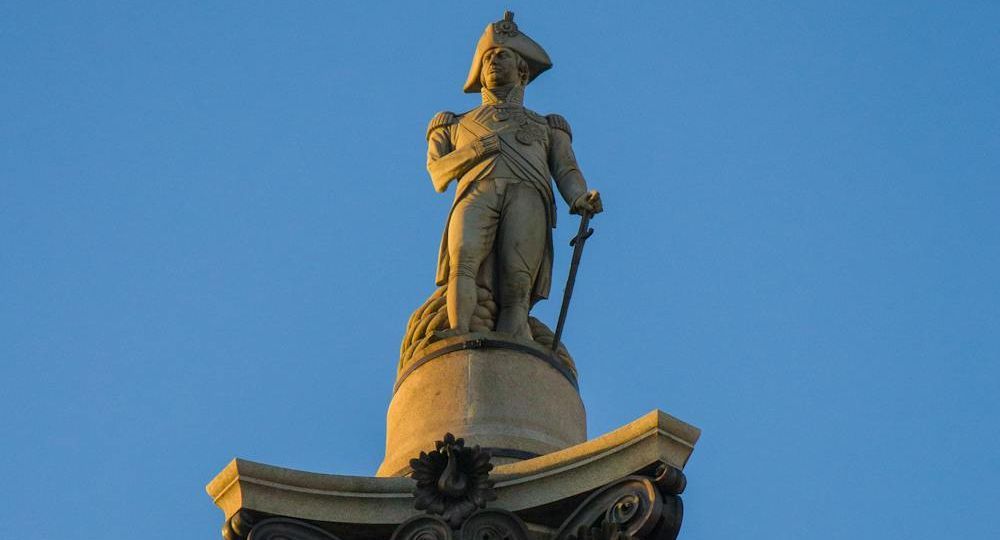 Image: Gregory-S
If you ever visit London’s iconic Trafalgar Square, you’ll likely come across a towering column topped by a statue of a stern-looking Royal Navy officer. This monument, known as Nelson’s Column, is a fitting tribute to Vice-Admiral Horatio Nelson, the hero of the Battle of Trafalgar. During this 1805 battle, the British Navy faced a formidable Spanish fleet. However, Nelson’s brilliant strategies secured victory—though he tragically lost his life from injuries sustained in combat.
Charles de Gaulle
 Image: Umberto di Capua
Like George Patton, Charles de Gaulle is regarded as one of France’s greatest heroes. As a military officer, he led the Free French forces during World War II, playing a key role in restoring democracy to France. After the war, he chaired the provisional government of the French Republic until 1946. In 1958, he was elected President of France, a position he held until 1969.
William the Conqueror
 Image: Maxwell Andrews
Much like Alexander the Great, many consider William I, the first Norman king of England, the ruler most deserving of the title William the Conqueror. As Duke of Normandy, William achieved what few had: invading England and claiming the throne after the death of Edward the Confessor. While he remains a divisive figure, his numerous statues in France and beyond stand as lasting tributes to his legacy.