Ye olde!

Forget about "thee" and "thou", here are 10 real Old English terms


Published on March 26, 2026
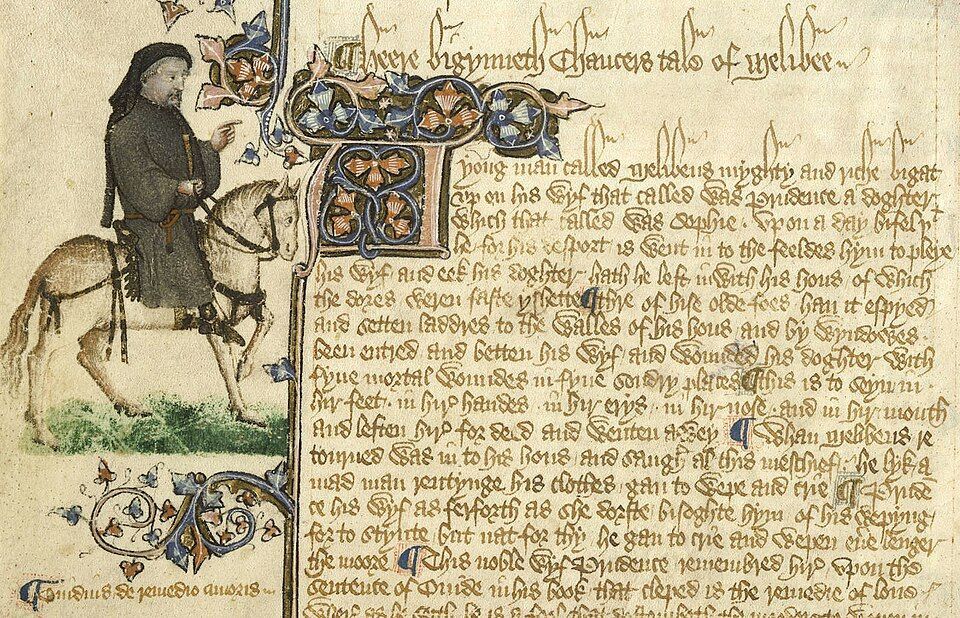

Image: unknown artist, 1400-1410, England, Public domain, via Wikimedia Commons

When people think about "Old English," they usually picture Shakespeare—all those thees, thous, and haths. But in reality, Shakespeare wrote in Early Modern English, which is practically current compared to the real thing. True Old English (or Anglo-Saxon) was spoken more than a millennium ago. It’s the language of Beowulf, filled with vivid, metaphorical words that describe the world in ways we’ve almost entirely forgotten. To understand the DNA of our modern vocabulary, we have to look back past the Renaissance to a time when the body could be described as a "bone-locker" and destiny was an inescapable force. Here are 10 Old English terms that reveal the epic, haunting roots of some of the words we use today.

1

Wyrd

Image: Darius Bashar

In Old English, wyrd wasn't an adjective for something "strange"; it was a powerful noun representing the inescapable force of destiny. The Anglo-Saxons believed that while a person had some agency, the ultimate weaving of their life was handled by forces beyond their control. In that sense, wyrd could be translated as "the way things are meant to be." This is where Shakespeare got the "Weird Sisters" in Macbeth—they weren't just odd; they were the "Fates."

2

Banloca

Image: dada_design

The Anglo-Saxons were masters of the "kenning," a compound expression with metaphorical meaning. Banloca literally translates to "bone-locker." It paints the human body not as a temple, but as a sturdy enclosure designed to keep your skeleton and spirit from wandering off. Interesting, don’t you think?

3

Úhtcearu

Image: cottonbro studio

If you’ve ever woken up at 4:00 a.m. and immediately started stressing about every mistake you’ve made since the third grade, you’ve experienced úhtcearu. Úht refers to the hour just before dawn, and cearu means "care" or "sorrow." In other words, it describes pre-dawn anxiety or what we might jokingly call the "3:00 a.m. scaries."

4

Beadurof

Image: svklimkin

This is a word you might find in an epic like Beowulf and would have been the ultimate Anglo-Saxon compliment. Beadu means "battle," and rof means "strong" or "valiant." It describes a very specific type of courage, the kind that flourishes only when the swords are drawn. To make it easier for modern readers, today it would translate into "battle-brave." Back then, it was the highest form of social currency.

5

Lufu

Image: RDNE Stock project

This is the direct ancestor of our modern word "love." While it sounds cute and fluffy now, the Old English lufu carried a weight of duty, affection, or religious devotion (such as the love of God). It shared roots with the Old High German lubo, emphasizing a deep, enduring bond rather than just a fleeting crush. It really took centuries to evolve into the lighthearted "love" we use today, even for pizza or hobbies.

6

Heofon-candel

Image: Timo Volz

Another brilliant kenning, heofon-candel, is a very poetic compound word. Heofon means "heaven" and candel, "candle." The Anglo-Saxons saw the sun as a guiding light placed in the sky by a higher power. The phrase suggests that the sun is a gift, a light set out in the house of the world by a divine creator.

7

Swefn

Image: Bruce Christianson

Did you ever have a dream that felt ominous or strangely significant? While we use the word "dream" today, the Anglo-Saxons had a more accurate term for those prophetic kinds of dreams, swefn. The word is related to other Germanic terms associated with sleep, such as Old English swefan ("to sleep"). Yet, to them, a swefn wasn't just a random brain-firing; it was often seen as a vision or an omen.

8

Maegth

Image: Kevin Delvecchio

The simple way to translate this term is with the word "family." But back in the Middle Ages, a family wasn’t just your mom, dad, and siblings. In a tribal society, your maegth was everything. It refers to your clan, your bloodline, and your extended family. If you didn't have a maegth, you were essentially a ghost in the eyes of the law. The maegth was actually responsible for paying wergild (blood money) if you committed a crime.

9

Andsaca

Image: maks_d

Literally, andsaca translates as "one who speaks against," meaning someone who denies, accuses, or opposes. In other words, it referred to an enemy, an adversary. But it wasn't just someone you disliked; an andsaca was someone who stood in direct opposition to your truth or your faith. In Old English literature, andsaca could describe spiritual enemies as well as literal monsters. In Christian texts, it was even used as a term for Satan, the ultimate adversary.

10

Wuldor

Image: Carlos N. Cuatzo Meza

Wuldor was a word used to express glory, splendor, or honor. It often referred to the radiance of God or the celebrated fame of a great king. In Old English, wuldor was the term for "celestial splendor." The word conveys more than simple praise—it suggests a brilliance of reputation or divine glory so powerful that it seems almost to shine.


Getting acquainted with your food

Deciphering food labels: are these things good or bad for you?


Published on March 26, 2026


Image: Jon Tyson

Food labels carry useful information for the informed reader. That may sound like a joke but it’s not. Most of us have casually tried to decipher the meaning of all those strange words and numbers on the back of a processed food item but gave up with little to show for it.

Most packaged foods are required to have a label with all sorts of information, including their ingredients, nutritional value, weights and measures, date, directions for use and storage, allergens, and more. Scroll down and learn more about these valuable details!

1

Dates

Image: Shannon VanDenHeuvel

Foods with a shelf life of less than two years must have a best-before or use-by date. But, while it sounds similar, these terms mean different things. The best-before date refers to food quality: food stored in the recommended way will remain of good quality until that date. Once the best-before date has passed, the food may still be safe to consume, but it may have lost some quality and nutritional value.

On the other hand, products with a use-by date on food labels should not be consumed after a certain date for health and safety reasons must-have a use-by date. This means they cannot be sold after that date.

2

Ingredients

Image: Dan Gold

Every label worth its salt must have its ingredients listed in descending order by weight, including added water. The first ingredient listed is present in the largest amount by weight, and the last one listed is present in the least amount by weight.

If an ingredient makes up less than 5% of the food, it does not have to be listed. However, this 5% rule does not apply to any additive or allergen. These must be listed no matter how small the amount.

Image: Joshua Fernandez

3

Food additives

Food additives can be used to improve the quality of a food or improve the flavour or appearance of a food. They must be used in the lowest possible quantity to achieve their purpose. These substances are included in the ingredient list according to their class and purpose (for example, anti-caking agent).

In most cases, a chemical name or food additive number will be listed after the class. For example, enzymes and most flavourings only need to list their class name or number. Luckily, the same food additive numbering system is used throughout the world.

4

Nutrition Information Panel

Image: Benjamin Cheng

The nutrition information panel tells the quantity of various nutrients a food contains per serve, as well as per 100 g or 100 ml. That serving size is determined by the manufacturer and will often vary among products.

This panel lists the energy content, proteins, total fat, saturated fat, carbohydrates, sugars, and sodium. Very small packages and foods like herbs, spices, salt, tea and coffee, or single-ingredient foods don´t need to show this information.

5

Nutritional claims

Image: Mockup Free

This one is tricky. The terms used by manufacturers present their products in a very positive light, even when there is no real value to be found.

For example, the term ‘light’ or ‘lite’ doesn’t necessarily mean that the product is low in fat, but it may refer to the texture, colour or taste of the product. If an item claims to be 93% fat-free, it contains 7% fat, but it looks so much better the other way. ‘Baked not fried’ sounds healthier, but it may still have just as much fat.

6

Percentage Daily Intake

Image: Eric Prouzet

Percentage Daily Intake (%DI) symbols display a product’s nutrient amount as one serving, and the percentage of an average adult’s requirements that it provides.

These symbols display energy, and other nutrients, like fat, sugars, sodium, carbohydrates, protein and a vitamin or mineral.

Keep in mind that %DI is based on serving size and, since serving sizes vary as they are set by manufacturers, it can be difficult to use when comparing products.

7

Allergens on food labels

Image: YesMore Content

Perhaps the most important item on this list is the information about food allergies or intolerance. Foods or ingredients that may cause severe adverse reactions must be declared on the label no matter how small the amount.

Common foods that may cause allergies are peanuts and other nuts, fish and shellfish, milk, eggs, wheat, sesame seeds and soy, among others. Gluten-containing cereals also need to be declared on food labels for people with conditions like celiac disease.

8

Country of origin

Image: P. L.

This type of labelling details where the product was grown, produced, made or packaged. Most packaged food must have a country of origin label if it's sold in a retail setting, such as a supermarket, local store or market, online or from a vending machine.

9

Sugar types

Image: Shayna Douglas

Different types of sugar have different names. Food manufacturers may use this to their advantage by purposely adding many different types of sugar to their products to hide the actual amount and, by doing so, they can list a healthier ingredient at the top, mentioning sugar further down. So even though a product may be loaded with sugar, it doesn’t necessarily appear as one of the first three ingredients.

To avoid inadvertently consuming a lot of sugar, watch out for any ingredients with the word "sugar", or "syrup", on their composed names.

10

Sodium types

Image: Mockup Free

In the same way it happens with sugar, sodium also can be disguised under many different names. For example, there’s salt, sodium benzoate, disodium or monosodium glutamate, to name a few.

This is important to know because too much sodium can raise blood pressure, increasing the risk of heart disease and stroke. The American Heart Association recommends no more than 1,500 milligrams of sodium a day.

Looking for an extra scoop of literary fun?

Learn more with our Word of the day

embroil

/ɛmˈbrɔɪl/