Ye olde!

Do you know what the Old English word for love is? Not what you'd expect!


Published on March 26, 2026
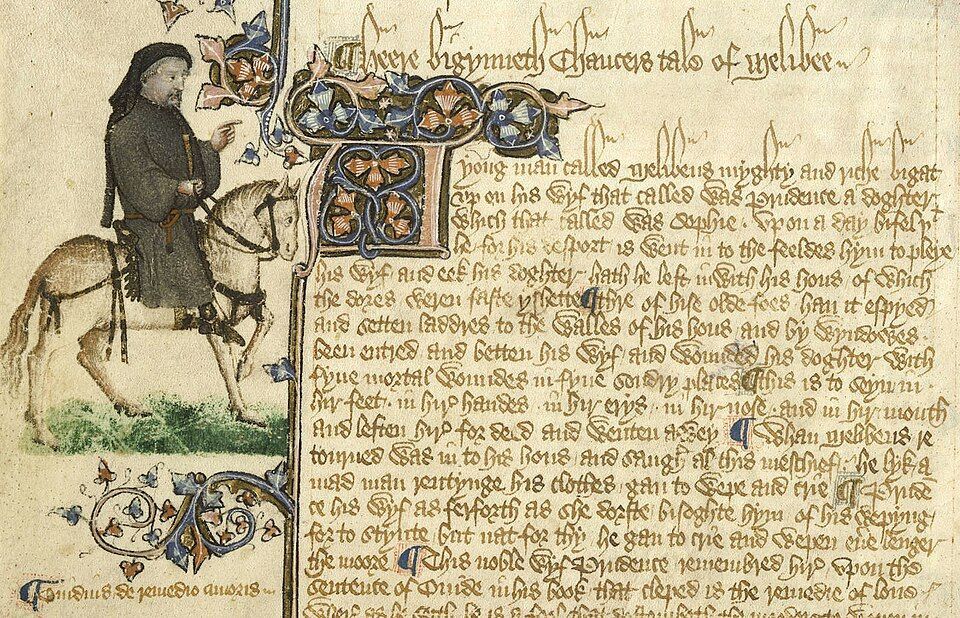

Image: unknown artist, 1400-1410, England, Public domain, via Wikimedia Commons

When people think about "Old English," they usually picture Shakespeare—all those thees, thous, and haths. But in reality, Shakespeare wrote in Early Modern English, which is practically current compared to the real thing. True Old English (or Anglo-Saxon) was spoken more than a millennium ago. It’s the language of Beowulf, filled with vivid, metaphorical words that describe the world in ways we’ve almost entirely forgotten. To understand the DNA of our modern vocabulary, we have to look back past the Renaissance to a time when the body could be described as a "bone-locker" and destiny was an inescapable force. Here are 10 Old English terms that reveal the epic, haunting roots of some of the words we use today.

1

Wyrd

Image: Darius Bashar

In Old English, wyrd wasn't an adjective for something "strange"; it was a powerful noun representing the inescapable force of destiny. The Anglo-Saxons believed that while a person had some agency, the ultimate weaving of their life was handled by forces beyond their control. In that sense, wyrd could be translated as "the way things are meant to be." This is where Shakespeare got the "Weird Sisters" in Macbeth—they weren't just odd; they were the "Fates."

2

Banloca

Image: dada_design

The Anglo-Saxons were masters of the "kenning," a compound expression with metaphorical meaning. Banloca literally translates to "bone-locker." It paints the human body not as a temple, but as a sturdy enclosure designed to keep your skeleton and spirit from wandering off. Interesting, don’t you think?

3

Úhtcearu

Image: cottonbro studio

If you’ve ever woken up at 4:00 a.m. and immediately started stressing about every mistake you’ve made since the third grade, you’ve experienced úhtcearu. Úht refers to the hour just before dawn, and cearu means "care" or "sorrow." In other words, it describes pre-dawn anxiety or what we might jokingly call the "3:00 a.m. scaries."

4

Beadurof

Image: svklimkin

This is a word you might find in an epic like Beowulf and would have been the ultimate Anglo-Saxon compliment. Beadu means "battle," and rof means "strong" or "valiant." It describes a very specific type of courage, the kind that flourishes only when the swords are drawn. To make it easier for modern readers, today it would translate into "battle-brave." Back then, it was the highest form of social currency.

5

Lufu

Image: RDNE Stock project

This is the direct ancestor of our modern word "love." While it sounds cute and fluffy now, the Old English lufu carried a weight of duty, affection, or religious devotion (such as the love of God). It shared roots with the Old High German lubo, emphasizing a deep, enduring bond rather than just a fleeting crush. It really took centuries to evolve into the lighthearted "love" we use today, even for pizza or hobbies.

6

Heofon-candel

Image: Timo Volz

Another brilliant kenning, heofon-candel, is a very poetic compound word. Heofon means "heaven" and candel, "candle." The Anglo-Saxons saw the sun as a guiding light placed in the sky by a higher power. The phrase suggests that the sun is a gift, a light set out in the house of the world by a divine creator.

7

Swefn

Image: Bruce Christianson

Did you ever have a dream that felt ominous or strangely significant? While we use the word "dream" today, the Anglo-Saxons had a more accurate term for those prophetic kinds of dreams, swefn. The word is related to other Germanic terms associated with sleep, such as Old English swefan ("to sleep"). Yet, to them, a swefn wasn't just a random brain-firing; it was often seen as a vision or an omen.

8

Maegth

Image: Kevin Delvecchio

The simple way to translate this term is with the word "family." But back in the Middle Ages, a family wasn’t just your mom, dad, and siblings. In a tribal society, your maegth was everything. It refers to your clan, your bloodline, and your extended family. If you didn't have a maegth, you were essentially a ghost in the eyes of the law. The maegth was actually responsible for paying wergild (blood money) if you committed a crime.

9

Andsaca

Image: maks_d

Literally, andsaca translates as "one who speaks against," meaning someone who denies, accuses, or opposes. In other words, it referred to an enemy, an adversary. But it wasn't just someone you disliked; an andsaca was someone who stood in direct opposition to your truth or your faith. In Old English literature, andsaca could describe spiritual enemies as well as literal monsters. In Christian texts, it was even used as a term for Satan, the ultimate adversary.

10

Wuldor

Image: Carlos N. Cuatzo Meza

Wuldor was a word used to express glory, splendor, or honor. It often referred to the radiance of God or the celebrated fame of a great king. In Old English, wuldor was the term for "celestial splendor." The word conveys more than simple praise—it suggests a brilliance of reputation or divine glory so powerful that it seems almost to shine.


Exploring unusual toponyms

Enjoy a ha-ha moment with the 10 funniest town names around the world


Published on March 26, 2026


Image: Pixabay

Do you see yourself visiting Accident or spending a few days skiing in Drama? How about a long weekend in Boring, or a nice vacation in Hell? Check out these 10 towns and cities with the most curious names in the world, including one impossible to pronounce and another, well, let's just say non-existent.

1

Accident, Maryland

Image: US government, Public domain, via Wikimedia Commons

Accident is a small town located in the plateau region of the Appalachian Mountains in Maryland. Two different accounts explain the curious name of this Garrett County town of less than 350 inhabitants. Both versions involve a man named Deakins and date back to the mid-18th century when the lands of the United States were open for settlement.

The more widespread story indicates that, after King George II of England granted Deakins 600 acres of his choice, he commissioned two groups of engineers to determine the best site. To his surprise, and "by accident", both selected the same plot of land. Accident was officially incorporated in 1916 and if you ever visit, you should know that any person from this town is called an "Accidental."

2

Saint-Louis-du-Ha! Ha!, Canada

Image: MTI

It may sound funny, but it's no joke. Saint-Louis-du-Ha! Ha!, a parish municipality of the Bas-Saint-Laurent region of Quebec, Canada, sits on a hill in the Appalachian Plateau, 400 meters above sea level. It was named in 1874 and in 2017 was granted the Guinness World Record for being the only city in the world with more than two exclamation points in its name.

The origin of the Ha! Ha! has been the subject of various interpretations. However, the Quebec Toponymy Commission solved the mystery. In reality, ha-ha is a French archaism that designates a dead end or an unexpected obstacle. In this case, the obstacle in question was Lake Témiscouata, which had to be crossed to reach the village. Time took care of distorting the word and granting us this peculiar toponym.

3

Frankenstein, Missouri

Image: Kenny Eliason

Contrary to what you might think, this town in northwestern Osage County, Missouri was not named after the famous monster created by Mary Shelley. It is believed that the origin of the name of this unincorporated community located just 12 miles from Jefferson City is a tribute to a pioneer citizen named Gottfried Franken who donated land in 1890 for the construction of a church.

At the time, the donated area was popularly known as Franken Hill, although a post office called Frankenstein was established in 1893. So, how did it end up being called that? One possible explanation may be related to the fact that many of the early settlers of Frankenstein came from the Westphalen area of Germany. The full toponym probably derives from the German stein, which in English means "rock."

4

Llanfairpwllgwyngyllgogerychwyrndrobwllllantysiliogogogoch, Wales

Image: manuzoli

No, it's not a computer error and you're not having a vision problem. Llanfairpwllgwyngyllgogerychwyrndrobwllllantysiliogogogoch is the full name of a village located on the island of Anglesey in Wales and is probably the weirdest name on this list. With 58 characters, this charming destination has the longest name in Europe and the second-longest one-word place name in the world.

It was given this name in 1869 for the sole purpose of attracting tourists. However, unless you are fluent in Welsh, it is unlikely that you’ll be able to pronounce it correctly; it is a real tongue twister! Translated to English, it means: "St Mary's Church in the Hollow of the White Hazel Near to the Rapid Whirlpool of Llantysilio of the Red Cave." But don't worry, you don't have to memorize it all, to make things easier the locals call it Llanfairpwll or Llanfair PG for short.

5

Nameless, Tennessee

Image: Yannik Mika

There is no consensus regarding the origin of the unusual name of this unincorporated community in Jackson County, Tennessee. As is always the case in these situations, there are a few rumors going around. One theory suggests that when residents applied for a post office they forgot to fill in the name field. The U.S. Post Office Department didn't give it a second thought and in 1866 just returned the application with "Nameless" stamped on the form.

In his book Blue Highways: A Journey Into America, travel writer William Least Heat-Moon offers another version. He recounts that the locals finally decided to call their town Nameless because they couldn't agree on a name: some suggested patriotic themes, others preferred something related to nature. Apparently, a fellow who was fed up with the discussion said: "This here's a nameless place if I ever seen one, so leave it be." And that's just what they did.

6

Hell, Norway

Image: Tollef Salemann, CC0, via Wikimedia Commons

"Welcome to hell," writes someone in the caption of their Instagram post of a selfie next to a blue sign. Although the name of this Norwegian village probably finds its origin in the word hellir, which means "cave" in Old Norse, travelers from all over the world love to take pictures of themselves at the Hell train station and make jokes like "See you in Hell," or "I have been to Hell and back."

The town of Hell is located in the province of Trøndelag, in the central part of the country, very close to the Trondheim Fjord and the Norwegian Sea coast. However, instead of fire and sulfur, this quiet town is home to cold temperatures and ice-covered streets. Yes, there's a place on Earth where hell freezes over!

7

Drama, Greece

Image: Panos Deligiannidis

Unlike the ancient Greek tragedies, in which Prometheus rebels against the gods and Oedipus kills his own father, the peaceful city of Drama surprisingly does not live up to its name. In fact, it was named after Hydrama —meaning "rich in water"—, a city with excellent water resources believed to have been in the same place in classical times.

Located in the Macedonian region of northeastern Greece, Drama is surrounded by green hills, breathtaking waterfalls, and miles of pristine nature to explore. The area is known for having the lowest temperatures in the country, which offers the unusual opportunity to ski on Mount Falakro, just an hour's drive away.

8

Kissing, Germany

Image: Dark Avenger at German Wikipedia, Public domain, via Wikimedia Commons

With a name like Kissing, you might expect this town to be full of loving couples walking hand in hand in the sunset. Located just outside of Augsburg, one of Germany's oldest cities, Kissing is home to beautiful small churches and large green spaces, perfect for romance and courtship. However, while it is true that it has a lot of charm, you don't have to be a romantic to enjoy this bucolic Bavarian village.

In fact, the first certain mention of this municipality goes back to the year 935 when it was called Chissingun. This toponym probably derives from the Old High German male name Kiso/Cisso. Fun fact: the surname Kissinger —as in Henry Kissinger— means inhabitant of Kissing. Did you know?

9

Boring, Oregon

Image: everett mcintire

Boring is anything but boring. This town in the state of Oregon does its best to get rid of that negative connotation and invites visitors to take funny pictures at the entrance sign. Not only that, in 2012 it was paired with the village of Dull, Scotland. Along with Bland, Australia, the three towns are informally —and humorously— called the "Trinity of Tedium."

The town of Boring, located in the foothills of the Cascade mountain range, is named after a former Civil War soldier named William Boring who donated land for the first school. But, as you might imagine, few pay attention to this little detail. As with the Norwegian town of Hell, all sorts of witty phrases come up. "I had fun in Boring, OR" is one of our favorites.

10

Batman, Turkey

Image: Clément Falize

Nameless places, accidents, monsters, the longest name: this list has it all. That's why we couldn't say goodbye without adding a superhero to the mix. In southeastern Turkey, there is a large city called Batman, home to almost 500,000 people. Although there is no link between the fictional character and this urbanization, the history of its name is full of curiosities.

Turkey's third-largest city actually got its current name a few years after artist Bob Kane and writer Bill Finger created the Dark Knight. This place, formerly called Iluh, changed its name in 1957, in homage to an eponymous river called Batman since the 19th century. And why is the river called that? There is a simple explanation: In Turkey and Persia, a batman is an ancient unit of measure.

Looking for an extra scoop of literary fun?

Learn more with our Word of the day

welfare

/ˈwɛlˌfɛr/