No, Atlantis is not on this list

What does Brazil mean? Discover the origin of 10 countries’ names


Published on October 19, 2025
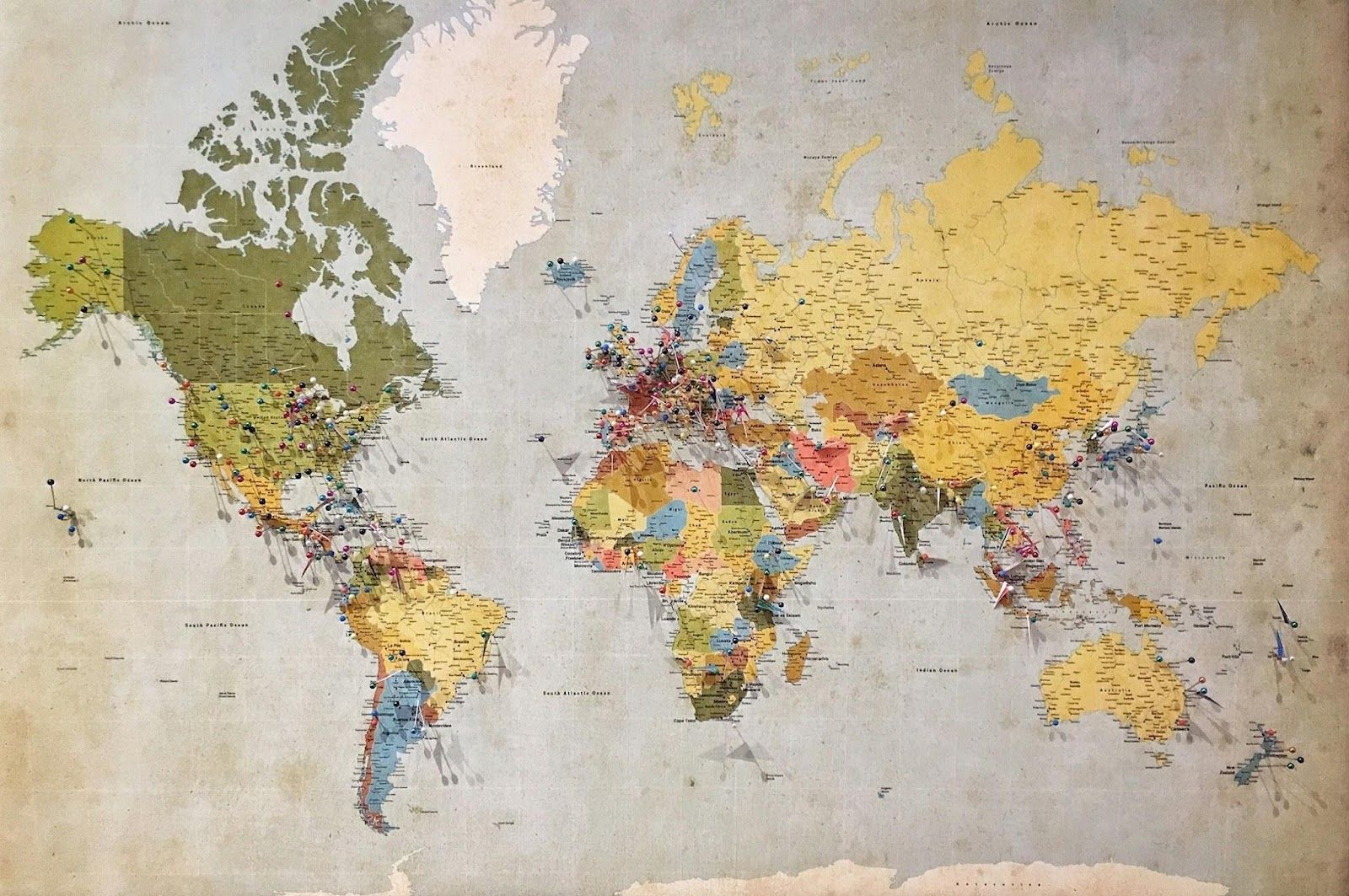

Image: Andrew Stutesman

Some things are never questioned simply because they’ve always been that way. But even countries have origins—and so do their names. Some names are quite straightforward from the beginning: The United States of America is exactly that—a union of states in America. But others, like Brazil or India, are not quite as simple. Scroll on to learn about the origin of ten countries’ names. You might just pick up a cool little fact to share with your friends.

1

Canada

Image: Xavier von Erlach

It might seem curious that a country so vast is named after a small settlement—but it is. The name Canada likely comes from the Huron-Iroquois word kanata, meaning "village" or "settlement." The first official use of Canada as a name came in 1791, when the Province of Quebec was divided into the colonies of Upper Canada and Lower Canada. In 1841, the two colonies were united under a single name: the Province of Canada.

Then, on July 1, 1867, the provinces of Canada, Nova Scotia, and New Brunswick joined to form "one Dominion under the name of Canada."

2

Argentina

Image: Scottsdale Mint

This South American country’s name first appeared on a Venetian map in 1536. Argentina means "(made) of silver" or "silver-colored" in Italian, derived from the Latin argentum, meaning silver. The name was originally associated with the legend of the "Silver Mountains," which was widespread among the first European explorers of the La Plata Basin.

In 1860, a presidential decree officially established the country’s name as the Argentine Republic, and that year’s constitutional amendment recognized all names used since 1810 as legally valid.

3

Spain

Image: Fidel Fernando

A close connection with rabbits is probably not the first thing that comes to mind when you hear the word Spain. But that connection plays a role in the origin of the country’s name. The earliest version, Hispania, is believed to have come from the Phoenician word i-spn-ya, which the Romans interpreted as "land of rabbits" or "region rich in rabbits."

Other theories suggest that Hispania may derive from a Punic word meaning "land of metals" or from an Iberian or Basque root referring to the region's geography, but rabbits is the widely popular theory.

4

Norway

Image: Vincent Guth

Norway’s name origin makes sense—it comes from the Old English word Norþweg, first mentioned around 880, meaning "northern way" or "way leading to the north." This is how the Anglo-Saxons referred to the Atlantic coast of what is now Norway. The same idea aligns with the leading theory about the origin of the country’s name in the Norwegian language.

5

India

Image: Nathan Anderson

The name India is derived from a corruption of the word Sindhu, the ancient name of the Indus River. Neighboring peoples, particularly the Persians, pronounced the "s" as "h" and referred to the land as Hindu. The Greeks later adapted this to Indos, which led to the Latin India.

The name India was known in Old English, but under French influence, it was sometimes replaced by Ynde or Inde. The form Indie appears in the first edition of the King James Bible and the works of William Shakespeare, both from the late phase of Early Modern English.

6

Australia

Image: Bob Walker

Quite fittingly, the name Australia is derived from the Latin australis, meaning "southern," and specifically from the hypothetical _Terra Australis_—a "southern land" postulated in pre-modern geography.

The name was popularized by the explorer Matthew Flinders in 1804, and it has been in official use since 1817, replacing New Holland, an English translation of the Dutch name first given in 1643 to the continent.

7

Cameroon

Image: note thanun

The name of this Central African republic comes from the name given by the Portuguese to the Wouri River, which they called Rio dos Camarões, meaning "river of shrimps" or "shrimp river," in reference to the once-abundant Cameroon ghost shrimp. Today, the country’s name in Portuguese remains Camarões.

8

Brazil

Image: niko photos

This beautiful country takes its name from the pau-brasil tree, which was once plentiful in its coastal forests. Pau is a colloquial Portuguese word for "wood" or "tree," and brasil comes from brasa, meaning "ember"—a reference to the tree’s reddish sap, once used for dyeing cloth. Today, the wood of the pau-brasil is prized for making cello and violin bows.

9

Greenland

Image: Jeremy Cai

Someone who has never seen a picture of Greenland could be forgiven for thinking the country is covered in green, lush pastures—after all, the name implies just that. So how did this ice-covered island come to be called Greenland? It got its name from the Norwegian adventurer Erik Thorvaldsson, better known as Erik the Red, in 985 A.D.

The popular explanation is that the name was a kind of public relations strategy to encourage settlement. However, ice core and mollusk shell data indicate that between 800 and 1300 A.D., the island’s temperatures were considerably warmer than they are today—so perhaps Erik was simply reacting to a greener landscape that has long since vanished.

10

Moldova

Image: Ariana Prestes

Moldavia was a historic principality along the Danube River, ruled successively by the Ottomans, the Russians, and the Romanians before becoming the Moldavian Soviet Socialist Republic after World War II. After the dissolution of the Soviet Union in 1991, it adopted the name Moldova, after the Moldova River.

Local lore attributes the name to a Transylvanian prince whose favorite hunting dog, Molda, drowned in the river. While this makes for a charming origin story, the name more likely derives from a Proto-Indo-European root, melh, meaning "dark," or from the Gothic word mulda, meaning "dust."


Beyond the spotlight

10 unsung heroes who changed history


Published on October 19, 2025


Image: Roman Kraft

History books are filled with the feats of famous figures, yet many unsung heroes are left out of their pages. From fearless explorers to groundbreaking inventors and champions of equality, these individuals have shaped the world in ways that still impact us today. Here’s a look at 10 lesser-known figures whose contributions deserve recognition.

1

Rosalind Franklin

Image: digitale.de

Rosalind Franklin was a chemist whose X-ray diffraction images were crucial to understanding DNA’s double-helix structure. Her meticulous research and pioneering techniques significantly advanced molecular biology and provided insights into the molecular structures of materials like coal and graphite.

Franklin’s work laid the foundation for James Watson and Francis Crick’s discovery of DNA’s structure, for which they later received the Nobel Prize. However, her groundbreaking contributions remained largely unrecognized until recent years.

2

Michael Collins

Image: Brian McGowan

Michael Collins is the often-overlooked third member of Apollo 11, the 1969 mission that landed the first humans on the Moon. While Neil Armstrong and Buzz Aldrin explored the lunar surface, Collins orbited alone in the command module, ensuring their safe return to Earth.

Though he never set foot on the Moon, Collins played a critical role in the mission’s success, operating the spacecraft and conducting experiments while patiently awaiting his crewmates.

3

Hedy Lamarr

Image: Austrian National Library

Hedy Lamarr was a Hollywood actress renowned for her beauty and talent, but few know she was also a brilliant inventor. Despite having no formal training and being primarily self-taught, Lamarr designed various inventions, including improved traffic stoplights and a tablet-based carbonated drink.

During World War II, she co-developed frequency-hopping spread spectrum technology to prevent enemy interception of radio signals. This innovation later became the foundation for modern wireless communication systems like Bluetooth and Wi-Fi.

4

Tenzing Norgay

Image: Kalle Kortelainen

Tenzing Norgay, a Nepalese Sherpa, became a legendary figure in 1953 when he and Sir Edmund Hillary became the first climbers confirmed to reach the summit of Mount Everest. By that time, Norgay had already participated in more than six expeditions to the mountain.

His skill, endurance, and deep knowledge of the treacherous Himalayan landscape were crucial to their success in conquering the world’s highest peak. Despite his vital role, Norgay received less recognition than some of his companions, who were knighted, while he was awarded only an honorary medal. He later dedicated himself to training future Sherpas and climbers, passing on his expertise to a new generation of mountaineers.

5

Bessie Coleman

Image: Shaun Darwood

Bessie Coleman was the first African American woman to earn a pilot's license, obtaining her wings in 1921 after training in France due to racial discrimination in the United States. She not only fought for racial equality but also shattered barriers in a male-dominated field, inspiring many women to pursue aviation.

After earning her license, Coleman performed daring aerial stunts, becoming a celebrated airshow performer known as "Queen Bess" and "Brave Bessie." During her career—tragically cut short by a plane crash in 1926—she even trained with Anthony Fokker, one of the world’s most renowned aircraft designers.

6

Ibn Battuta

Image: Vaida Tamošauskaitė

Ibn Battuta was a 14th-century Moroccan explorer who traveled extensively across Africa, the Middle East, India, and China, covering approximately 75,000 miles across three continents over 29 years. His travels, documented in a detailed account titled The Rihla, provide an invaluable account of the diverse cultures, religions, and societies of his time.

Much like Herodotus, Battuta’s detailed observations offer historians unique insights into the medieval world, enriching our understanding of the places he visited.

7

Virginia Apgar

Image: Tim Bish

Virginia Apgar was an American obstetrical anesthetist who developed the Apgar Score in 1952, a rapid test used to assess a newborn's health immediately after birth. This 10-point evaluation measures heart rate, breathing, muscle tone, reflexes, and skin color to identify any critical issues in the first moments of life, revolutionizing neonatal care.

To this day, the Apgar Score remains a global standard in hospitals, helping to save countless infant lives and improving newborn survival rates worldwide.

8

Karl Schwarzschild

Image: NASA Hubble Space Telescope

Karl Schwarzschild was a German physicist and astronomer who amazingly while serving in the German army during World War I, formulated the first exact solution to Einstein’s equations of general relativity through a series of letters with Einstein.

His groundbreaking discovery laid the foundation for modern astrophysics, influencing everything from theoretical models to space exploration. Though Schwarzschild died soon after, his work remains fundamental to our understanding of the universe.

9

Henrietta Lacks

Image: Drew Hays

Henrietta Lacks, an African American woman, unknowingly changed modern medicine. In 1951, doctors at Johns Hopkins Hospital discovered that her cancer cells had an extraordinary ability—they could survive and reproduce indefinitely outside the body. Known as HeLa cells, they became the first "immortal" human cells, revolutionizing medical research.

HeLa cells have since contributed to the development of the polio vaccine, cancer treatments, and numerous medical breakthroughs. However, her story has also sparked ongoing ethical debates about consent and bioethics in medical research. Despite this, Lacks’s cells remain vital to scientific advancements today.

10

Alexander Mackenzie

Image: Maxime Doré

Scottish explorer Alexander Mackenzie made history in 1793 as the first European to cross North America by land, reaching the Pacific Ocean. His expedition through Canada’s rugged wilderness predated the Lewis and Clark expedition by over a decade, mapping previously uncharted territories.

Mackenzie’s journey provided valuable insights into the continent’s interior and its trade potential. His achievement laid the foundation for Canada’s westward expansion and demonstrated the vast possibilities of traversing North America’s untamed frontiers.

Looking for an extra scoop of literary fun?

Learn more with our Word of the day

contemplate

/ˈkɑn(t)əmˌpleɪt/