Military lingo

10 military terms that made it to the civilian vocabulary


Published on June 25, 2026
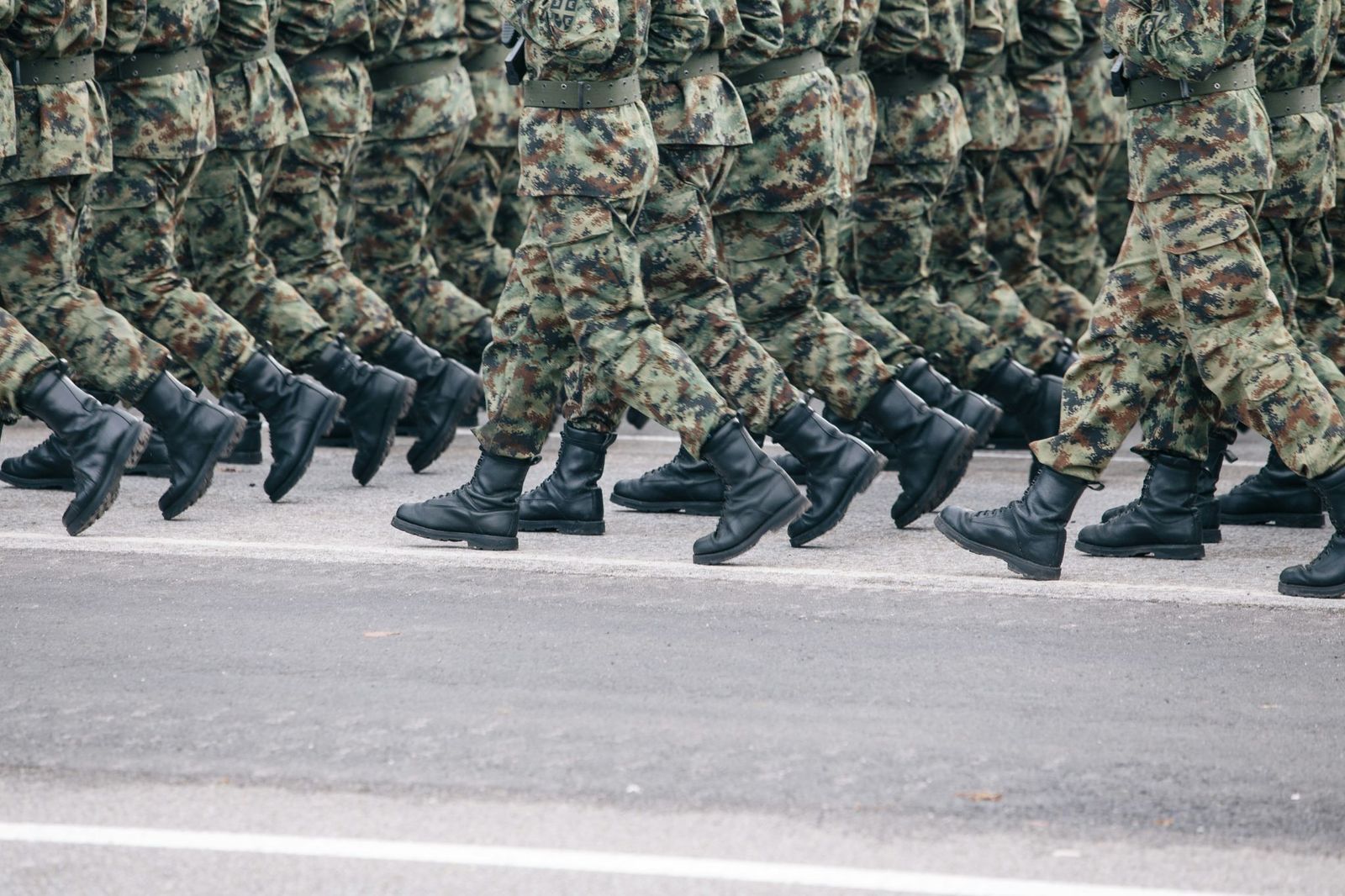

Image: Filip Andrejevic

Our everyday vocabulary is littered with terms, phrases, idioms, and concepts drawn from different contexts—such as medicine, science, sports, politics, etc.—often altered or reinterpreted. The military world is no exception, and every day we use phrases that originated in war contexts or that were popularized by soldiers. Let’s have a look at some examples!

1

ASAP

Image: ostudio

One of the most widespread phrases popularized by military use, this acronym originated not in the armed forces but in the dental hygiene field as part of a list of recommended abbreviations for secretaries. However, it was adopted by the military around the 1950s and widely used during the Korean War. While it was conceived to mean "as soon as practically possible", its use in the military context shifted its meaning to "immediately".

2

No man’s land

Image: Alex Streif

Have you ever described an ambiguous or unclear situation as "no man’s land"? Well, that phrase was initially used for actual land, and it is still used that way. Popularized during WWI as a descriptor of the barren land between opposing trenches, it had been in use for centuries for unoccupied or unclaimed wastelands, often in dispute among bordering jurisdictions. While we now often use it figuratively, it is used in its literal sense in conflict zones and territorial disputes.

3

Deadline

Image: Towfiqu barbhuiya

Our modern life is hectic and filled with deadlines, but these, although important, don’t usually pose a threat to our lives. The original deadlines, though, were a different story. The phrase emerged during the American Civil War, and it referred to the boundary lines drawn around prisoner camps. Any prisoner who crossed the line was instantly shot, effectively making it a ‘deadline’. Luckily for us, its meaning has shifted to reflect a time limit.

4

Cup of joe

Image: Emre

If you ever wondered about the connection between coffee and someone named Joe, several theories claim to have the answer. The most popular one —although refuted by many historians— links it to Josephus "Joe" Daniels, famous for banning alcohol in the Navy, which allegedly popularized coffee as a substitute. A more likely theory points to the term ‘jamoke’ (a contraction of java + mocha), widely used in the military around the 1930s.

5

Feeling blue

Image: Joanna Derks

The color blue has traditionally been associated with melancholy, but military men might have had a hand in popularizing this idiom. Though blue flags currently carry a different meaning in nautical terminology, they were once used as a sign of mourning. If a ship’s captain or other high-ranking officer died at sea, their ship would fly a blue flag and paint a blue band around the hull, a custom that intertwined the color blue with sadness.

6

AWOL

Image: Vaz Mann

If we think about it, most of the time we say someone’s AWOL, a leave is not required. We are simply stating that we don’t know where they are or why they left. But the case is quite different for its military use. First recorded in the 18th century, it was used as a full phrase, although it eventually became an initialism around WWI and then an acronym around WWII. Still in use in the military, it carries a more dire meaning than in the civilian context.

7

Murphy’s law

Image: Sarah Kilian

"Anything that can go wrong will go wrong." All of us have invoked Murphy’s law at some point in our lives, but who’s Murphy? The answer takes us to a U.S. Air Force base and a series of rocket tests during the late 1940s. After several mishaps, aerospace engineer Edward A. Murphy famously exclaimed: "If there are two or more ways to do something and one of those results in a catastrophe, then someone will do it that way." Murphy’s frustration was later summarized at a conference as "Anything that can go wrong will go wrong", and the rest is history.

8

Roger

Image: engin akyurt

Most people wouldn’t be surprised to learn that this phrase is of military origin, but not many would be able to explain how it came to mean ‘understood’. During WWII, the American and British forces used the Able-Baker alphabet for radio communications, where Roger (and not Romeo) represented the R. ‘Roger’ meant your message had been received and understood. While most militaries later shifted to the NATO alphabet, the use of roger as ‘understood’ stuck and was popularized by its use in the Apollo lunar missions.

9

Got your six

Image: Ocean Ng

While not as commonly used as other phrases of military origin, most people know that if someone tells them "I got your six," it means they have their back. The phrase stems from WWI aviators using the 12-hour clock face to describe directions: 12 o’clock was the front, 6 o’clock the back, and 3 and 9 o’clock the sides. As a blind spot, the back was a pilot’s most vulnerable area, so a wingman who ‘got their six’ was always appreciated.

10

Run amok

Image: Jordan Whitt

People telling a story about rambunctious children running amok would hardly imagine that this phrase has quite the violent origin. In Malay and Javanese cultures, amuk was used to describe warriors who launched frantic and violent attacks, often associated with a spiritual possession. The term was introduced into English by 16th-century European explorers, but it was Captain James Cook who popularized the phrase "run amok."


Ready, set, vocabulary!

Learn these 10 sport-related expressions and win hands down!


Published on June 25, 2026


Image: Ben Hershey

Popular idioms appear in conversation all over the English-speaking world every minute of the day and we hardly ever stop to think about where they come from. Have you ever heard someone say "I'll have to start from scratch"? Have you wondered what "in the nick of time" means? What all these expressions have in common is that they originated in the world of sports. Want to know more? Get the upper hand and discover all those phrases you often say but didn’t know are related to games and sports!

1

Down to the wire

Image: The Royal Danish Library

Down to the wire is an idiom used to describe a situation, sporting or otherwise, whose outcome is not decided until the very last minute. This expression comes from horse racing and experts suggest it originated in America in the late 19th century.

Before the days of televised sports, racetracks would string a wire across the finishing line above the riders’ heads. A steward would then be placed at a vantage point, looking down the line so that a winner could be more easily established during neck-and-neck finishes. The first written record of the phrase can be found in an 1889 article from Scribers Magazine and since then it has been widely used, even today.

2

At the drop of a hat

Image: Pixabay

You’ve probably used this expression many times, but did you know it has a sport-related origin? The phrase can be easily traced back to the 19th century when sporting referees, who usually wore hats, would raise one into the air, alerting competitors to be ready. Then, they would drop it to signal the start of the event. The method was commonly used in boxing and horseracing, where the races or matches were considered started "at the drop of a hat".

Nowadays, the phrase is used to imply something would be carried out immediately, without delay. It is sometimes thought to be of American origin but the practice has long been used by English-speaking people on both sides of the Atlantic.

3

Upper hand

Image: light wizzi

To have the upper hand implies that a person has the advantage or control over someone or something in a particular situation. In sports, when a team goes first in a game we say they have the upper hand. But where exactly did this expression originate? Well, there are many theories and none are definitive.

Some suggest that this phrase dates back to the 15th century and is related to an obsolete pastime. In this game, the first player grips a shaft at the bottom end while the next places their hand just above it until the upper end of the shaft is reached. Finally, when the last person takes the last grip, it means they have the "upper hand".

Later, in the 20th century, this method of finding a random winner was often used in baseball and cricket when hands would be placed on a bat and the last to take a grip got to play the game first.

4

Wild goose chase

Image: Anastasiia Krutota

Have you ever embarked on a foolish and hopeless search for something unattainable? Then probably, even figuratively, you were involved in a wild goose chase. A wild goose chase is a fruitless pursuit with no hope of a successful outcome and was coined in England in the late 16th century.

Back in the 1500s, it was an expression used in relation to a kind of equestrian sport in which all the competitors had to follow accurately the course of the leader at definite intervals, like a flight of wild geese. The term was regularly applied to the sport but it appears to have been Shakespeare who altered the meaning to one of hopeless pursuit.

5

Start from scratch

Image: Gonzalo Facello

Nowadays, to start from scratch is a saying we use to illustrate starting again from the beginning, regardless of how much we have already achieved of a task. However, in medieval times it had a more literal meaning.

Back then, in certain sports like cricket, horse racing, or boxing, a line or mark was "scratched" into the ground by either a sword or a javelin to indicate the point from which competitors had to start. If they cut corners, they would have to start again from this scratch.

Over the years this idiom has been shortened to from scratch and is also used to indicate that we are going to start something with no assistance, for example, a recipe that we make using every ingredient raw instead of processed foods.

6

In the nick of time

Image: Jason Weingardt

When something gets done in the nick of time it has been done at the very last possible minute, before it was too late. Achieving things just at the critical moment can make us nervous, but when it comes to sports, scoring just before the clock determines the end of the game can change the mood of more than one fan.

In this case, nick is used in the sense of "the precise moment of an occurrence or an event." However, the literal form of the phrase dates from the late 16th century when a tallyman would keep the scores for team games. This person would carve a nick or dent in a piece of wood each time a team scored and if the winning nick was added during the last minute it was known as the "nick in time."

7

Lose your bottle

Image: Gustavo Fring

When someone has lost their bottle they have lost their nerve and their bravery. Contrary to what you may think, this expression has nothing to do with liquor courage. In fact, this phrase originates from the world of bare-knuckle prizefighting during the late 19th and early 20th centuries.

In a fighter’s corner, one of his seconds was known as "the bottle man" and his job was to supply water to a fighter between rounds. Without water, a fighter was unable to continue and sometimes it was known for cornermen to be asked to walk away and leave when a fighter was taking a beating, to provide an excuse for him to drop out. The phrase "lost his bottleman" was later shortened and popularly used to describe cowardly behavior.

8

Win hands down

Image: Raquel Elise de Moraes

This is a widely used expression in the world of sport but it has extended to all aspects of life. To win hands down suggests a very comfortable, easy victory. Its roots can be found not in poker but in horse racing. In the 19th century, winning hands down meant that a jockey was so certain of his victory in the closing stages of a race that he could lower his hands and relax his grip on the reins.

Even today, when a jockey is winning comfortably he can gallop down the finishing straight without using his whip to encourage the nag along. The shortened version hands down is a metaphor of ease extended beyond the domain of horse racing and is used today to convey "without a doubt, no question."

9

Bandy about

Image: gerhard crous

If someone's name, an idea, or a story are bandied about it means they are being discussed frequently by many people in a casual or informal way. What you probably didn't know is that this phrase originated in France and is related to the world of sports.

The game of Bander was an early form of tennis and involved hitting a ball to and fro. Later, in the 1600s, the Irish invented a team game, a hockey predecessor, that required a group of people bandying a ball between them. They called the sport Bande after the French game because of the similarities between the two ideas. Also, they used a crooked stick that later led to the term bandy-legged to refer to those with bow legs.

10

Across the board

Image: Iván Hernández-Cuevas

Simply put, across the board means all-encompassing, wide-ranging, and applying to all. Like many of the idioms included in this article, this one also has roots in horse racing. In the U.S., this expression referred to a bet in which equal amounts were staked on the same horse to win, place, or show in a race.

In the 19th century, large boards would be used to display the odds on a horse to come first, second, or third in a given race. A popular bet was to place an even amount of money on just one horse for every possible outcome. This was known as an "across-the-board bet".

​​

Looking for an extra scoop of literary fun?

Learn more with our Word of the day

initiative

/ɪˈnɪʃədɪv/